Survival Tickets
Survival Tickets is not a DMV test. It is a survival guide for the roads of the USA.
I created this section because real critical situations — a police officer pulled you over, you got into an accident, your brakes failed, your phone died in the middle of the desert — are nowhere explained properly. The DMV teaches signs and rules, but it does not teach what to do when you are scared and confused.
Every ticket is based on real cases, state laws, and recommendations from NHTSA, AAA, highway patrol and attorneys. There is one goal — so that in a critical moment you do not panic, you know your rights, you know who to call and how to save your life. Read the tickets, take the tests — it sinks into memory and works when you need it.
Pulled over by police
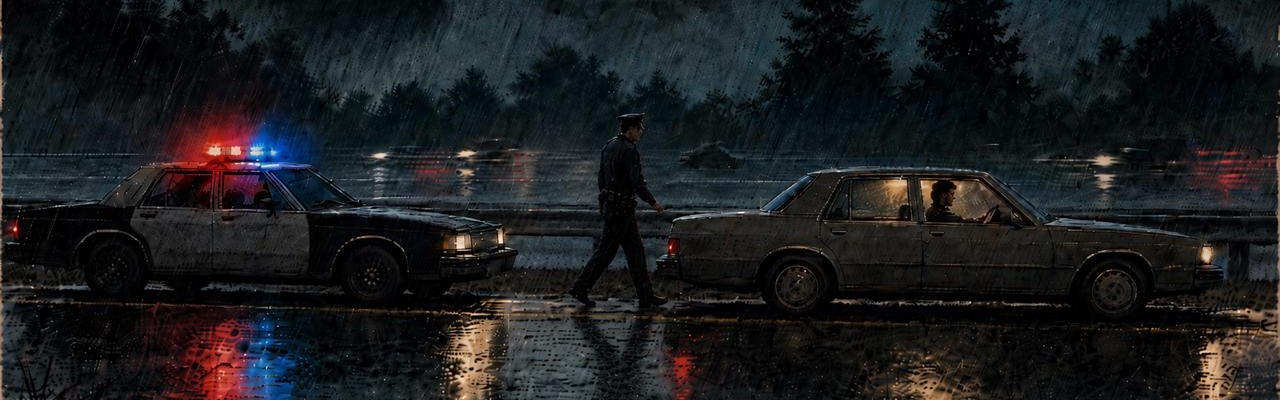
The situation
A police car with flashing lights orders you to pull over. Legally this is a seizure under the Fourth Amendment. Everything you do and say in the first few minutes can be used against you in court. By law the police are allowed to lie to you during the conversation, so your defense isn't counterarguments — it's calm and silence.
Reasons you can be stopped
Speeding, a traffic violation, a broken brake light or headlight, expired plates, window tint, a phone in your hand while driving, suspicion of drunk driving, a lookout for a similar vehicle, a random document check. The officer is required to state the reason for the stop — in California, under law AB 2918, they must do so BEFORE any questioning, and the reason must go into the report.
Step by step
- 1Turn on your right turn signal — it tells the officer you've seen them and are complying, not trying to flee.
- 2Pull over to the right shoulder, ideally in a lit, populated area — it lowers the risk for both you and the officer and gives you witnesses.
- 3Not sure the car is really a police car? Turn on your hazards, slow down, drive slowly to a busy, well-lit place, and you may call 911 and stay on the line — doing this is legal and is spelled out directly in the Texas DPS guidelines.
- 4Put it in park, shut off the engine, turn off the radio. At night, turn on the dome light — the officer should be able to see there's no threat inside.
- 5Roll down the window. Both hands on the wheel where they can be seen. Passengers — hands in view too. Most shootings at traffic stops happen because of movements toward hidden places.
- 6Don't reach into the glovebox, your pocket, or under the seat until told to. First say out loud: "My documents are in the glovebox, may I get them?" A sudden movement toward a spot the officer can't see is the most common cause of escalation.
- 7On request, hand over your license, registration, and insurance — this is required by law in every state. You are obligated to identify yourself.
- 8If there's a legal firearm in the car, say so right away and where it is — don't reach for it. In many concealed-carry states this is a legal duty.
Real cases
How it develops: what to react to and what not
Search
Without a warrant and without your consent, the officer has no right to search the car. Exceptions: they see something illegal in plain view (a bottle, a bag on the seat), smell something, or have probable cause. A pat-down of your person is allowed on reasonable suspicion that you're armed.
Your rights (memorize them)
The right to remain silent after identifying yourself. You are obligated to identify yourself and hand over documents. After that, say out loud: "I am invoking my right to remain silent." The law (the Fifth Amendment) flatly prohibits forcing you to testify against yourself. But the right only works if you state it.
The right to refuse consent to a search (the Fourth Amendment).
The right to ask: "Am I free to go?" If the officer says yes — calmly drive off. If no — you're being detained, and all the more reason to stay silent until you have a lawyer.
Signing a ticket is NOT an admission of guilt, only a promise to appear or pay. Refusing to sign leads to arrest in most states.
If you're arrested — the right to a lawyer. Say clearly: "I want a lawyer" — then go silent. "I think I probably need a lawyer" may not count as requesting one in the eyes of the court.
What to say
- "Officer, my license is in the glovebox. May I get it out?"
- "I do not consent to a search."
- "I am invoking my right to remain silent."
- "Am I free to go?"
- "I want a lawyer." (if arrested — and not another word)
What NOT to say
- Don't make excuses or explain why you were driving fast or that you were in a hurry.
- Don't apologize — "sorry" is treated in court as an admission of guilt.
- Don't lie to the officer: the law lets them lie to you, but not you to them.
- Don't argue on the roadside about whether the officer is right — that argument belongs in court.
Specific situations
Life hacks
- 1Keep your documents in one fixed spot (the visor or glovebox) and know that spot by heart — so you won't have to dig and fumble nervously in front of the officer.
- 2At night, turn on the dome light before the officer even reaches you — it immediately eases their tension and suspicion.
- 3Write down the officer's name and badge number, the patrol car number, the time, and the place — useful if you decide to challenge their actions.
- 4Recording on your phone is legal in most states, but don't pull out the phone silently — announce out loud: "I'm starting a recording," and place the phone in plain view.
- 5Disagree with the ticket? Don't argue on the spot for a second. Sign, smile, drive off, contest it in court: there you actually have a chance, on the roadside — zero.
- 6Make every movement slowly and narrate it: "I'm going to reach into the glovebox for the registration now." Predictability is your main defense.
- 7If you sense the officer is angry and escalating — don't add fuel. Minimum words, maximum compliance; the goal is to end the encounter alive and drive away.
Key facts
- A traffic stop is the most common contact an American has with police — tens of millions of stops a year.
- You are required to identify yourself and, on request, show your license, registration, and insurance — in any of the 50 states.
- The implied-consent law applies in all 50 states: refusing a chemical test after arrest means an automatic license suspension, up to 1 year in most states.
- A field breath test before arrest is voluntary; a chemical test (blood or breath) after arrest is mandatory.
- Signing a ticket is not an admission of guilt — only a promise to appear in court or pay.
- The officer must state the reason for the stop; in California (law AB 2918), before any questioning, and the reason goes into the report.
Test yourself
- a) Hit the gas and try to lose it
- b) Turn on your right signal and pull over
- c) Get out and walk toward the officer
- d) Brake hard in your lane
- a) Reach in silently and fast
- b) Say it out loud and ask permission first, moving slowly
- c) Ask the officer to get them
- d) Grab them early, digging around the car before the officer arrives
- a) Stay quiet — if not asked, don't tell
- b) Tell the officer right away and where it is, without reaching for it
- c) Take it out and set it on the dash
- d) Hide it under the seat
- a) Are required to agree
- b) May politely decline: "I do not consent to a search"
- c) Must get out and open the trunk
- d) Must explain why you refuse
- a) Mandatory — refusing means arrest
- b) Voluntary; but a chemical test after arrest is mandatory
- c) Mandatory only at night
- d) Illegal in the US
- a) Argue with the officer on the roadside
- b) Refuse to sign it
- c) Sign it and contest it in court
- d) Tear up the ticket
Answers and explanations
In a car accident
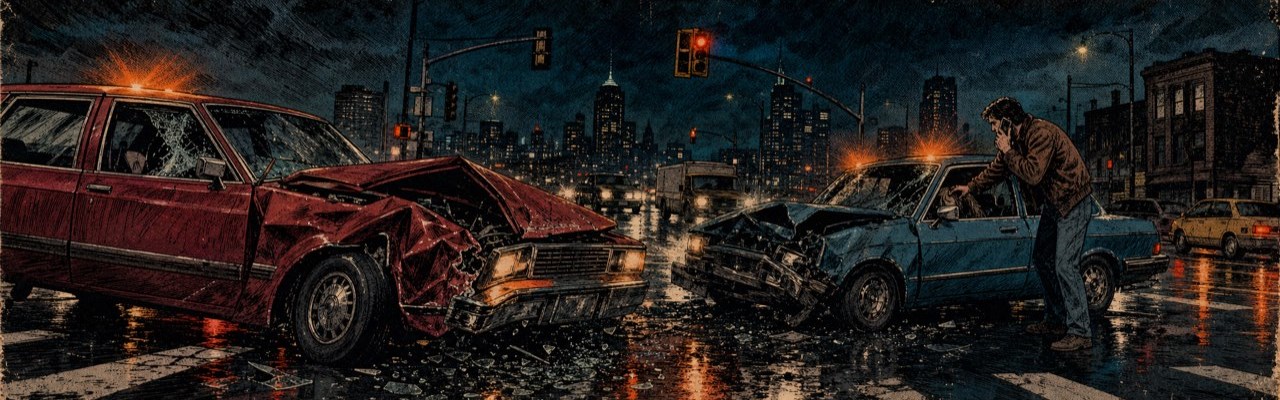
The situation
A collision with another car. The first 60 seconds decide whether this stays an insurance matter or turns into a criminal one. The key rule recognized by NHTSA, AAA, and the DMV of every state: stop, make yourself known, call for help if there are injuries, exchange information — and under no circumstances drive away. Leaving the scene of an accident turns a civil insurance question into a criminal offense (hit and run) in all 50 states.
Step by step
- 1Stop immediately, even if the impact is minor. Turn on your hazards. Don't drive off to "deal with it later" — leaving is a separate offense, more serious than the accident itself.
- 2Check yourself and your passengers for injuries, then the people in the other car. Adrenaline masks injuries; you'll only know for sure that you're "fine" about an hour later.
- 3Injuries, fire, a fuel leak, or a car blocking traffic — call 911 right away. Don't call relatives or your insurer first; every second counts.
- 4If the car still runs and there are injured people — do NOT move the injured, except for a direct threat of fire or traffic. Moving someone improperly with a spinal injury can leave them disabled.
- 5If everyone is unhurt and the car still runs — move it out of the lane of traffic (in Florida, this is explicitly required by law for minor accidents).
- 6Exchange information: name, address, license number, plate and state, insurer and policy number, make/model/year. Photograph the other driver's license and insurance.
- 7Document the scene: wide and close-up photos of the damage to all cars, the position of the cars, skid marks, signs, traffic light, weather, visible injuries. Get witnesses' contact info before they leave.
- 8Write down the name and badge number of the responding officer and the case number before you leave the scene.
- 9Report to your insurer quickly — most policies require notification within 24–72 hours.
- 10See a doctor the same day, even if you feel fine. An early medical record is the strongest evidence in an injury claim.
Why you can't drive off, even if the bump is trivial
Real cases
How it develops: what's important to understand
Your rights
The right not to admit fault. You're required to identify yourself, share your information, and — if there are injuries — help and call for aid, but no law requires you to admit fault or explain your reasons. "At fault or not" is decided later.
The right to get the police report. You may request a copy of the report and the case number. It's your document for the insurer and the court.
The right to your own medical care. You can call an ambulance and see your own doctor regardless of what the other driver says.
The right to file against the other insurer. If the other driver is at fault, you may claim compensation from their insurer — even if you have no insurance yourself.
What to say
- To the police — only facts: direction of travel, signals, what you saw, the speed you can confirm exactly.
- To your insurer — the same facts; ask for the claim number, and check whether a rental car is covered.
What NOT to say
- Don't admit fault and don't apologize — even "sorry" at the scene is treated as an admission.
- Don't say "I didn't see you," "I was going about 60" if that's a guess, or "it's my fault."
- Don't take or offer cash to "settle on the spot without police" — hidden damage and delayed injuries can exceed the amount tenfold.
Specific situations
Life hacks
- 1Keep ready on your phone: your insurer's number, your policy number, photos of your license and insurance — so you won't be searching under stress.
- 2Keep a pen and paper in the glovebox: technology fails exactly when you need to write down a plate and details.
- 3Photograph BEFORE the cars are moved: the position of the cars at the moment of stopping is key evidence of who was going where.
- 4Shoot not only your car and the other one, but also a wide shot with the signs and traffic light — it shows the context of the accident.
- 5Never discuss fault at the scene, even out of politeness. "Oh, it's probably my fault" — the insurer/court will use it against you.
- 6Get a copy of the police report (usually 3–10 business days, $5–15) — your insurer and the court will need it.
- 7See a doctor on the day of the accident, even with no complaints. A record saying "examined on the day of the accident" is stronger than any words a month later when your neck starts to hurt.
- 8Don't accept cash to "hush it up without police" — frame repairs and treatment surface later, and by then you have no evidence.
Key facts
- Leaving the scene of an accident (hit and run) is a crime in all 50 states, even with minor damage.
- Every party to an accident is required to stop and exchange information — the law demands it in every state.
- When there are injuries, call 911 first — before the insurer and before relatives.
- Most insurance policies require you to notify them of an accident within 24–72 hours.
- Adrenaline masks injuries: neck and back pain often shows up only a day or two later.
- A copy of the police report is usually available within 3–10 business days.
Test yourself
- a) Drive off to "deal with it later"
- b) Stop and turn on your hazards
- c) Chase them down and talk while moving
- d) Rub out the scratch and drive on
- a) Relatives
- b) Your insurer
- c) 911
- d) A mechanic friend
- a) Yes, pull them out right away
- b) No, don't touch them, except for a threat of fire or traffic
- c) Move them into your car
- d) Sit them upright
- a) Agree and drive off
- b) Decline: hidden damage and injuries surface later
- c) Take the money and call the police anyway
- d) Haggle over the amount
- a) No, since there are no dents
- b) Yes, the law requires it either way
- c) Only if asked
- d) Only if there are witnesses
- a) No need, since nothing hurts
- b) The same day, even with no complaints
- c) In a week, if it starts to hurt
- d) Only if an ambulance was called
Answers and explanations
Hit a pedestrian
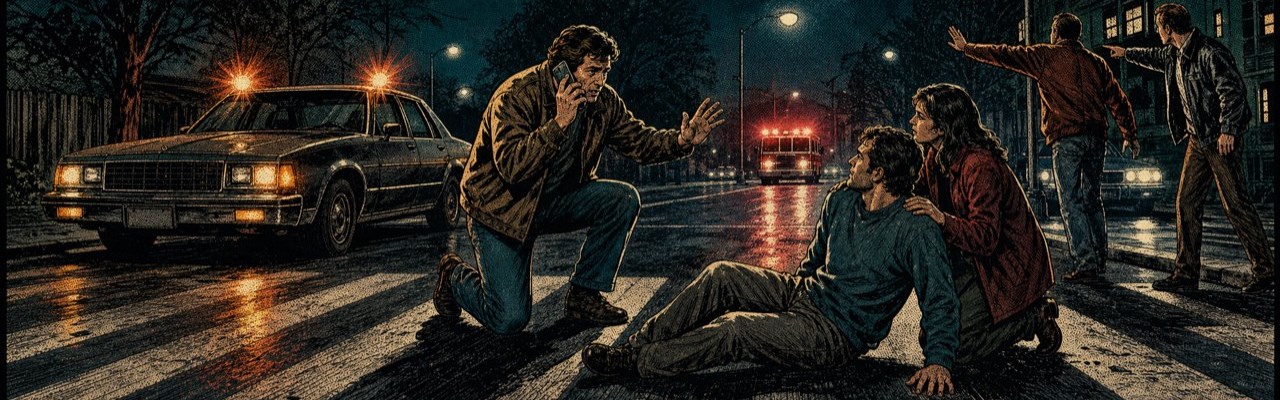
The situation
You've hit a person. This is the situation with the most severe consequences on the road. Criminal liability here ranges from a traffic fine to vehicular manslaughter and even murder if there were aggravating factors. Your actions in the first minute determine not only the victim's fate, but also whether you walk away from this a free person. According to NHTSA, in 2024, 7,080 pedestrians died in the U.S. and more than 71,000 were injured — these cases are investigated as harshly as possible.
Step by step
- 1Stop immediately and completely. Leaving the scene after hitting a pedestrian is a felony in almost every state, and it's many times more serious than the accident itself. You must stop even if you're sure the pedestrian is at fault (ran a red light, was drunk, wasn't using a crosswalk).
- 2Turn on your hazards. If you can, move the car slightly out of traffic — but only without driving away from the victim.
- 3Call 911 immediately, even if the person gets up and says "I'm fine." Adrenaline masks serious internal injuries; "fine" can turn into death within an hour, and then you're the one who fled the scene if you left.
- 4Provide reasonable help within the limits of your training: cover the person so they don't get cold, apply pressure to a wound if there's heavy bleeding — but do NOT move them, don't give food, water, or medicine, and don't set anything. Moving someone with a spinal injury can leave them disabled for life.
- 5Cooperate with the responding officer: hand over your license, registration, insurance. Write down the case number and the officer's name and badge.
- 6Photograph the scene before the cars are moved: your position and the pedestrian's, the crosswalk, traffic light, road markings, skid marks, lighting, weather. Get witnesses' contact info.
- 7Notify your insurer the same day. Facts only, no admission of fault.
- 8Before giving any statement to the other party or their lawyer, consult your own lawyer, especially if the injuries are severe. This isn't "hiding" — it's basic protection, directly recommended by attorneys.
A real case: why to stay and why the consequences are so severe
First — a combination of factors turns an "accident" into "murder." A simple collision is one thing. Collision + alcohol + double the speed limit + a crosswalk + fleeing — that's already implied malice, a conscious disregard for life, and the law classifies it as murder.
Second — fleeing doesn't save you, it sinks you. They identified her anyway from paint and debris. The fatal hit-and-run became a separate fifth charge on top of the murder. Had she stayed, helped, and called 911, she'd still have answered for drunk driving and speeding, but not for fleeing, and the charges could have been lighter.
Third — status, money, lawyers, sincere remorse ("I'm not a murderer, I would have driven into a tree rather than hit children," she wrote to the judge) don't override the mechanics of the law. Facts from the black box and paint from the bumper carry more weight than any words or money.
How it develops: what's important to understand
Your rights
The right to stay silent about fault after identifying yourself. You're required to identify yourself and hand over documents. But you don't have to speculate about fault, estimate your speed "by eye," or answer questions beyond the facts — that's the Fifth Amendment. Say out loud: "I'll answer factual questions; the rest is for my lawyer."
The right to a lawyer before detailed statements. All the more so when the victim's injuries are severe. Getting a lawyer before a detailed interview is protection, not a sign of guilt.
The right not to give a recorded statement to the other side. The insurer or the victim's lawyer can't compel you into a recorded interview — politely postpone it until you've consulted your own lawyer.
The right to document the scene. You may photograph the site, the position of the cars, and take witnesses' contacts — as long as it doesn't interfere with helping the victim.
What to say
- To the police — only facts you can confirm exactly: direction of travel, what the traffic light showed, what you saw, when you noticed the person. State the speed only if you're sure of it (the black box will show the truth anyway — don't lie).
- To the paramedics/911 — where you are, how many are injured, their condition, what you see (bleeding, unconscious, breathing/not).
What NOT to say
- Don't admit fault and don't apologize. "Sorry, I didn't see you" at the scene is both an admission of guilt and an admission of inattention at once, and it will be used against you.
- Don't offer to pay for treatment directly — any word and any payment are treated as an admission.
- Don't give a recorded statement to the other party's lawyer before consulting your own lawyer.
- Don't speculate ("I was probably going fast") — a guess becomes evidence.
Specific situations
Life hacks
- 1Your first physical action after stopping isn't to go argue with the pedestrian, but to call 911. Time here directly = the person's life and the severity of your charge.
- 2Don't move the victim "to a safe place" with good intentions — with a spinal injury this cripples them. There's only one exception: a direct threat of fire or traffic.
- 3Photograph the position of the bodies and the car BEFORE the ambulance arrives, if it doesn't interfere with helping — afterward everything gets moved, and this is key evidence of who was where.
- 4Stay absolutely silent about fault. In shock people apologize reflexively — that very phrase sinks them in court. The investigation will establish the facts.
- 5A modern car's black box records speed, braking, throttle. Lying about your speed is pointless and dangerous — they'll catch you in the lie, and it will make the case worse.
- 6Immediately write down the officer's name/badge and the case number — without the report, neither the insurer nor your lawyer can work properly.
- 7Get your own lawyer before any detailed statements if there are severe injuries. This is standard defense, not a sign of guilt.
- 8Remember the hierarchy of decisions: staying and helping (worst case — you answer for the accident itself) versus leaving (a separate felony on top of everything + you'll almost certainly be found). The choice is always obvious.
Key facts
- According to NHTSA, in 2024, 7,080 pedestrians died in the U.S. and more than 71,000 were injured.
- Leaving the scene after hitting a pedestrian is a felony in almost every state.
- You're required to stop, help, and give your information even if the pedestrian broke the rules.
- Criminal and civil liability run in parallel — an insurance payout doesn't close the criminal case.
- A modern car's black box (EDR) records speed, braking, and throttle — lying about your speed is pointless.
- In California, fleeing with injury is a felony with a 90-day minimum (§20001); in Florida, fleeing a fatal accident is a first-degree felony, minimum 4 years.
Test yourself
- a) No, since it's their fault
- b) Yes, always, even if the pedestrian is at fault
- c) Only if there are witnesses
- d) Only if there are injuries
- a) Let them go and drive off
- b) Call 911 anyway and take their contact
- c) Give them some cash just in case
- d) Drive them to a pharmacy
- a) Yes, carry them to the sidewalk
- b) No, don't touch them, except for a threat of fire or traffic
- c) Put them in your car
- d) Stand them up
- a) Walk over and figure out who's at fault
- b) Call 911
- c) Call your insurer
- d) Photograph and drive off
- a) Give it right away
- b) Consult your own lawyer first
- c) Refuse to identify yourself
- d) Admit fault to soften it
- a) Yes, lowball it
- b) No — the black box will show the truth anyway
- c) Say the speedometer is broken
- d) Say nothing about the car at all
Answers and explanations
Hit an animal (deer, dog, boar)
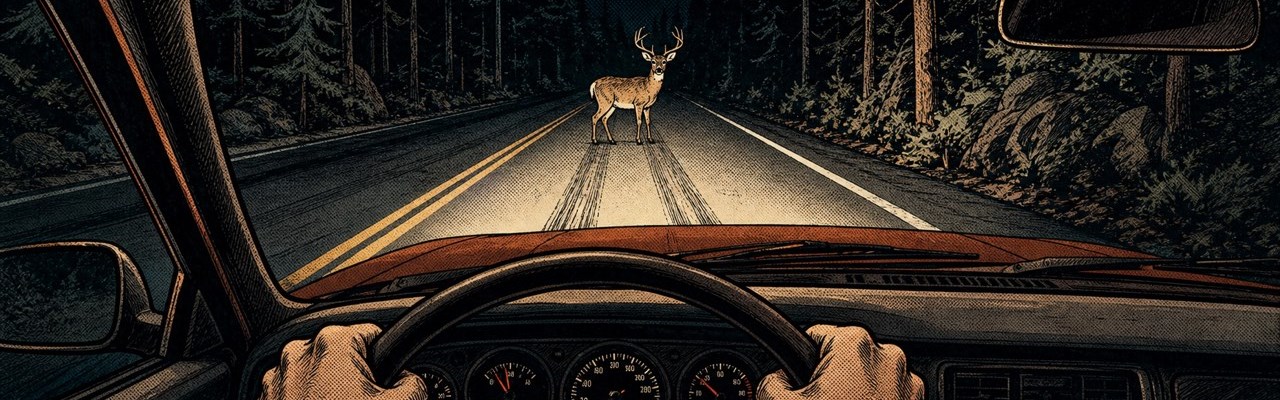
The situation
A collision with an animal on the road is one of the most common traffic incidents in the U.S. According to State Farm, there are roughly ~2 million deer collisions every year, plus hundreds of thousands with other animals. Hitting a large animal at speed (a deer weighs 130–300 lbs, a boar up to 400) can seriously damage the car and injure people. Small animals (dogs, cats) create a different problem — a legal one, since they're someone's property.
Step by step
If the animal is IN FRONT of you (you haven't hit it yet)
- 1Brake and keep the wheel straight — this is critical. Do NOT swerve sharply to go around it. A sharp maneuver is more dangerous than the impact itself: you could end up in oncoming traffic, roll over, hit a tree. Hitting a deer head-on is an insurance claim. Running off the road is deadly and more expensive.
- 2Honk and flash your headlights — sometimes the animal will move, but don't count on it. A panicked deer can jump right onto the hood.
After hitting a large animal (deer, boar, moose)
- 1Stop safely, turn on your hazards. Don't rush out to check the animal — first make sure stopping is safe for you and for traffic.
- 2Check yourself and your passengers for injuries. Adrenaline masks pain — you'll only know for sure you're "fine" about an hour later.
- 3Do NOT approach the animal, especially if it's alive. A wounded deer or boar is deadly dangerous. A deer's antlers, hooves (a deer can kick with its front hooves), 300 lbs of weight — these are weapons. A boar is even more dangerous: tusks, aggression, strength. Even if the animal seems dead, keep your distance. Only trained specialists (a wildlife officer, animal control) can safely handle wild animals.
- 4Call 911 or non-emergency police / highway patrol / animal control:
— 911 — if the animal is blocking the road and endangering other cars, or if there are injuries to people.
— Non-emergency / highway patrol / animal control — if the animal is on the shoulder or you're in a safe spot. They'll remove the carcass and file a report.
— You need the report for insurance — without it, they may deny the payout. - 5Photograph the scene: the car's position, the damage, the animal (if safe), road conditions, signs. Don't get close to the animal for the photo.
- 6Notify your insurer the same day. Say it was an animal collision, there is (or will be) a police report, and what the damage is.
- 7Do NOT try to drag the carcass off the road yourself. It's dangerous (the weight, traffic, the animal may revive and attack) and illegal in some states without a permit. That's the job of highway patrol or animal control.
- 8Check the car before driving on:
— The radiator for coolant leaks
— Whether the hood latched after the impact
— Whether the headlights and signals work
— Whether there's smoke from under the hood
— Whether the steering works normally (not bent)
If something's off — do NOT drive, call a tow truck. An overheated engine or bent steering at speed is deadly.
After hitting a domestic animal (dog, cat)
- 1You must stop. Domestic animals are someone's property. In most states, leaving the scene after hitting a domestic animal can be classified as an offense.
- 2Try to find the owner: check the collar (there's often a phone number), ask people nearby, knock on the nearest homes. If the animal has a chip, a vet or animal control will find the owner through the database.
- 3Call animal control — they'll take the animal and try to find the owner through the chip or a lost-pets database.
- 4If you didn't find the owner, leave a note at the spot where you hit it (on the nearest house, a post): your name, phone, what happened, the time, where the animal was taken (animal control or a vet). This is your legal protection.
- 5Notify the insurer — if there's damage to the car, it's covered by Comprehensive coverage.
How insurance works: who pays
Comprehensive coverage covers collisions with animals (wild and domestic), as well as falling objects, hail, theft, vandalism. This is NOT Collision coverage. The difference:
— Collision = you ran into another car or a stationary object (a post, a fence).
— Comprehensive = something ran into you or you collided with an animal (you couldn't have predicted it).
If you have Comprehensive:
— You pay the deductible (typically $100–500).
— The insurer covers the rest: repairing the car up to its actual cash value.
— A Comprehensive claim usually doesn't raise the premium as much as Collision (it's a "not at-fault" event).
If you only have Liability (the minimum required):
— Damage to your car is NOT covered. You pay out of pocket in full.
— Liability only pays for damage that YOU caused to OTHERS (but an animal isn't an "other" in the insurance sense).
Your injuries:
— Medical Payments (Med Pay) or Personal Injury Protection (PIP) covers your medical costs regardless of the type of accident.
— If you don't have it — you pay yourself or through health insurance.
Killing someone else's pet:
— Property Damage Liability may cover it if the owner files a claim (the animal is property). But it usually doesn't reach a lawsuit if you stayed at the scene and helped.
Statistics and reality
~2 million deer collisions every year in the U.S. (State Farm, Insurance Institute for Highway Safety). That's about 1 in every 170 cars per year in some states.
Peak season: October–December (deer mating season, when they're more active and unpredictable).
Time of greatest risk: dusk (5–7 p.m.) and dawn (5–7 a.m.) — deer feed along the edge of the forest and the road at those times.
The most dangerous states (odds of a deer collision in a year):
— West Virginia: 1 in 37 cars
— Montana: 1 in 39
— Pennsylvania: 1 in 52
— Michigan: 1 in 60
— Wisconsin: 1 in 68
Average repair cost after a deer collision: $4,000–6,000 (State Farm). It can be cheaper (a bumper dent, $1,500) or pricier (a total loss, $15,000+).
Phone numbers
— 911 — if the animal is blocking the road, there are injuries to people, or the animal is aggressive and dangerous.
— Non-emergency police — for a report, if the situation isn't an emergency.
— Highway patrol / animal control — to remove the carcass from the road. You can find the number by searching "[your state] highway patrol" or "[city] animal control."
— Utility company — if you hit a pole with wires (the number is usually on the pole).
Real cases
How it develops: what's important to understand
Your rights
The right not to admit "fault" for hitting a wild animal. An accidental collision with a deer that jumped out is not a crime; the insurer usually records it as a "not at-fault" event. Don't take on more than you should at the scene.
The right to a Comprehensive payout. If you carry that coverage, the insurer must cover the animal strike (minus the deductible). A police or animal-control report locks in your version.
The right not to touch the carcass. Clearing the animal off the road is the job of highway patrol and animal control; you can't be forced to do it yourself, especially when it's dangerous.
The right to close your duty with a note. If you hit a pet and couldn't find the owner, a documented note (name, phone, time, where it was taken) fulfills your duty to stop and report.
What to say
- To the police / animal control: Where, when, direction of travel, approximate speed, the type/size of animal (deer, dog, etc.). If it's a pet — a description (breed, color, collar).
- To the insurer: An animal collision (wild or domestic), the date, time, place, whether there's a police report (case number), the damage to the car, whether there are injuries to people.
What NOT to say
- Don't say you aimed at the animal on purpose — not even as a joke. Deliberately killing an animal can be classified as cruelty (especially a pet) or poaching (if it's protected wildlife).
- Don't take the deer meat without permission. In some states (Pennsylvania, Michigan, Wisconsin) you can keep deer meat with a wildlife officer's permission or through a special program. In others, it's poaching. Call the local wildlife agency and check. Without permission — don't touch it.
Specific situations
Don't approach a wounded animal. Wildlife officers train for years to safely handle wounded wild animals. You haven't. A deer can kill with a kick of a hoof or antler. Stay in the car, call 911 or animal control.
Life hacks
- 1Add Comprehensive coverage if the car is worth more than $3,000–5,000. It's cheap ($10–30/month depending on the car), but it covers not only animals but also hail, theft, vandalism. Without it, a deer collision is a total loss out of pocket.
- 2Driving through "deer country" (forest, rural areas) at dusk/dawn — drop your speed 10–15 mph below the limit. A deer leaps out of the forest in about 1 second; you don't have time to react at full speed.
- 3Saw one deer — expect more. Deer travel in groups. One crossed — 3–5 seconds later a second, a third runs after it. Don't speed up right after the first.
- 4A "Deer Crossing" sign — don't ignore it. These signs are placed where wildlife biologists have recorded frequent deer crossings (trails, watering spots, migration routes). It's not decoration — it's real data.
- 5If the animal on the road freezes and stares at you — brake and wait. Don't honk continuously — a panicked animal jumps unpredictably and can land right on the hood. One short honk, then brake and wait.
- 6Deer whistles (whistles on the bumper) are a myth. Studies have shown they don't work. A deer doesn't react to ultrasound at speed. Don't waste money.
- 7If you hit a pet and didn't find the owner — photograph the animal (if it's not too gruesome) and the note you left. It's proof you fulfilled the duty to stop and tried to find the owner, if the owner later says "you drove off."
- 8A dashcam proves you couldn't have avoided the hit — the animal jumped out suddenly. Useful in a dispute with the insurer if they try to say you could have prevented it.
- 9After hitting a deer, check the wheel alignment before a long trip. Hitting a large animal can bend the suspension. Driving with misaligned wheels on the highway — the car pulls, it's dangerous.
- 10If a dead deer is lying on the road (you didn't hit it) — don't just drive around it silently. Call highway patrol or 911 non-emergency. The next driver may not see the carcass at night and get into a serious accident. Your call will save someone's life.
Test yourself
- a) Swerve sharply to the side
- b) Brake and keep the wheel straight
- c) Speed up and dart past
- d) Close your eyes and hope
- a) Yes, drag it off the road
- b) No, keep your distance and call 911 / animal control
- c) Finish it off so it doesn't suffer
- d) Pet it to calm it down
- a) No, it's just an animal
- b) Yes — a pet is property, and leaving can be an offense
- c) Only if the owner is nearby
- d) Only if the dog is a purebred
- a) Collision
- b) Comprehensive
- c) Liability only
- d) None
- a) Yes, clear the road faster
- b) No, call highway patrol / animal control
- c) Push it with the car
- d) Drive around it silently and leave
- a) Yes, it's always yours
- b) Only with permission; otherwise it's poaching
- c) Only at night
- d) Only on your own land
Answers and explanations
Your car was hit and the driver fled (hit-and-run — you're the victim)
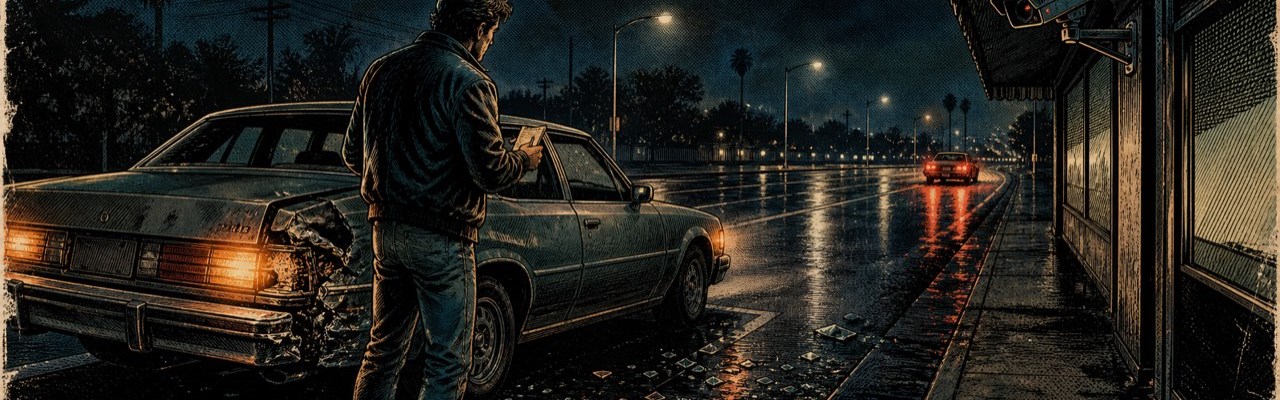
The situation
Someone hit your car and took off. That's a crime on the other driver's part (felony hit-and-run), but for you the question is: how do you get compensated when the perpetrator is never found? According to the Insurance Information Institute, ~13-16% of U.S. drivers carry no insurance. That's millions of people on the road who, in a crash, will either flee or be unable to pay for your damage.
Step-by-step actions
- 1Pull over safely and turn on your hazards. If the hit happened while moving and the other driver is nearby, try to note the license plate, make, and color from a distance. Do NOT chase them — it's dangerous and pointless.
- 2Check yourself and your passengers for injuries. Adrenaline masks pain — you won't really know whether you're "fine" until about an hour later.
- 3Call 911 if the at-fault driver is nearby and there's a chance to detain them, or if there are injuries. Otherwise, use the police non-emergency line to file a report.
- 4Document EVERYTHING before police arrive: the position of your car, the damage (wide shot and close-up), paint/glass fragments on the ground (they can identify the other vehicle), skid marks, the point of impact. If the driver fled, photograph the direction they left in against signs/addresses.
- 5Find witnesses IMMEDIATELY — in 5 minutes they'll be gone. Get names, phone numbers, emails. Ask nearby businesses whether they have cameras (stores, gas stations, homes with doorbell cameras). Write down those addresses.
- 6Memorize/write down everything you saw about the other driver: license plate (even partial), make/model (at least color and size — "gray sedan" or "white pickup"), distinctive features (stickers, dents, unusual details), direction of travel, exact time.
- 7File a police report within 24 hours — this is MANDATORY. Without a report, most insurers will deny a claim under uninsured motorist coverage. The report is legal proof that the crash happened and the driver fled.
- 8Notify your own insurer the same day, or within 24-72 hours at the latest. Tell them it's a hit-and-run, that there's a police report (or there will be within a day), and that you're tracking down witnesses and cameras.
- 9Photograph the damage to your car from every angle, before any repairs. Don't touch the other driver's paint fragments on your bumper — it's evidence.
- 10See a doctor the same day even without complaints. Whiplash and concussion show up later. An early medical record = strong evidence.
How insurance works: who pays when the driver fled
Here it's critical to understand the structure of your policy. Depending on which coverages you carry, the outcome differs radically:
If you have Uninsured Motorist (UM) coverage:
— Uninsured Motorist Bodily Injury (UMBI) — covers your injuries, medical costs, lost wages, and pain and suffering as if the at-fault driver had been insured. In many states a hit-and-run driver is legally treated as "uninsured." It applies up to your policy limit (for example, $25,000 per person / $50,000 per accident).
— Uninsured Motorist Property Damage (UMPD) — covers damage to your car in some states. Not available everywhere, a relatively cheap option. Important: in some states UMPD requires physical contact with the at-fault vehicle — if a nearby car just cut you off, you swerved and hit a barrier WITHOUT contact with it, UMPD may not apply (depends on the state).
If you have Collision coverage:
It covers damage to your car regardless of who's at fault or whether they're found. You pay the deductible (for example, $500), and your insurer pays the rest. After that, your insurer may try to recover from the at-fault driver (subrogation) — if they're found.
If you have Medical Payments (Med Pay) or Personal Injury Protection (PIP):
They cover your medical costs regardless of fault. PIP is broader — it can include lost wages, rehabilitation, and funeral costs. No-fault states require PIP.
If you only have Liability (the minimum required):
It covers nothing for YOU. Liability only pays for damage YOU cause to others. Your damage and injuries come out of pocket if the at-fault driver isn't found.
Phantom vehicle:
Example: a car cut you off, you swerved to avoid a collision, hit a barrier, and the car drove off WITHOUT contact with you. That's a "phantom vehicle." Many states let you file a UM claim, BUT: you must report it to police within 72 hours — mandatory. Without a report within 72 hours, denial is almost guaranteed.
Statistics and the reality of finding the driver
Hit-and-run cases get investigated, but the clearance rate is low. According to AAA, hit-and-runs happen every 43 seconds in the U.S. The clearance rate depends on severity (death = priority, a scratch = low priority) and available evidence (cameras, witnesses, left-behind paint). In cases with no injuries and no cameras, the clearance rate is around 10-20%.
If the at-fault driver is found after your insurer has already paid you:
Your insurer recovers (subrogation) from the at-fault driver or their insurer. You can get your deductible back through this process. If the driver is never found, your deductible is lost.
Phone numbers
— 911 — if the at-fault driver is nearby and there's a chance to detain them, or if there are injuries.
— Police non-emergency — to file a hit-and-run report without a chase.
— Your own insurer — within 24-72 hours, mandatory.
Real cases
How it develops: what's important to understand
Your rights
The right to a payout under your own policy as the victim. You may file a claim under UM, Collision, or PIP whether or not the driver is found. In many states a driver who fled is legally treated as uninsured.
The right to get the police report. You may request a copy of the report and the case number — without them, most insurers won't accept the claim.
The right to recover your deductible through subrogation. If the driver is later found, your insurer recovers the damage from them (subrogation), and you get your deductible back.
The right to pursue the driver directly. Beyond the insurance payout, you can seek punitive damages in court — leaving the scene is an intentional crime.
What to say
- To police — everything you remember: even a partial plate ("it started with 7AB"), the car's color/size, direction of travel, the time.
- To your insurer — the facts: where, when, what damage, whether there's a report (case number), whether you're tracking down witnesses and cameras. Don't fill in gaps — only what you actually saw.
What NOT to say
- Don't say "maybe it's my fault" or "maybe I'm to blame" — a hit-and-run means SOMEONE fled, and the law is on your side.
- Don't accept money from an unknown "good Samaritan" who could later turn out to be the at-fault driver or their representative.
Specific situations
Life hacks
- 1Add UM/UIM coverage to your policy NOW, not after a crash. It costs $3-6 a month for $25k/$50k of coverage. 13-16% of drivers uninsured means roughly one in six or seven.
- 2A dashcam is the best $50-200 investment. It automatically captures the plate, the face, everything. A hit-and-run with a dashcam = nearly 100% clearance.
- 3Keep a pen and paper in the glovebox in case your phone is dead/smashed — to write down the at-fault driver's plate by hand on anything.
- 4Right after the hit, repeat the other driver's plate out loud several times — your brain is in shock, and saying it aloud helps you remember.
- 5Photograph not just your car but also the other driver's paint chips on the ground/on your bumper — paint analysis can identify the make/model/year.
- 6If the driver fled and you're alone with no witnesses, file a report immediately anyway. There may be a camera on a neighboring house you don't know about, and police can request the footage.
- 7Know your UM claim deadline: often 30 days from the date of the crash. Don't drag your feet.
- 8If the driver is found a month later, you can pursue them directly (on top of the insurance payout) for punitive damages in court, since a hit-and-run is an intentional crime.
Test yourself
- a) Take off in pursuit
- b) Turn on hazards and note the plate/make/color from a distance
- c) Wipe the driver's paint off your bumper
- d) Drive straight to a repair shop
- a) Within 24 hours
- b) Within a month
- c) Anytime
- d) Only if there are injuries
- a) Liability
- b) UM (uninsured motorist)
- c) Nothing
- d) Only the other driver's insurance
- a) 24 hours
- b) 72 hours
- c) 10 days
- d) No need at all
- a) Your insurer, in full
- b) You, out of pocket
- c) The state
- d) The driver, in absentia
- a) Take it and drive off
- b) Decline — you need the report
- c) Haggle over the amount
- d) Agree if the sum is large
Answers and explanations
You hit a pole / fence / building
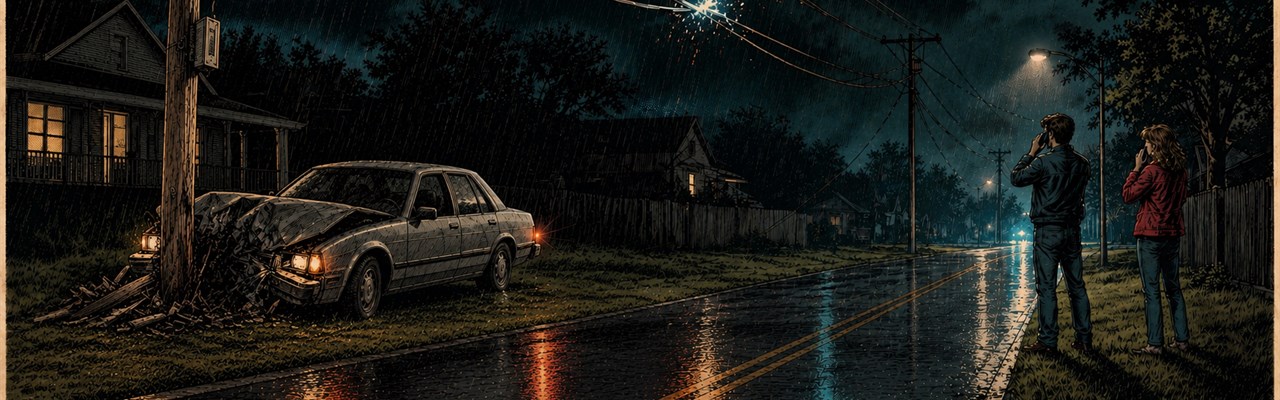
The situation
You hit a stationary object: a pole (telephone, electrical), a fence, a building, a tree, a barrier. This is a single-vehicle accident — there's no other driver, just you. Legally it's an at-fault accident (you're at fault) almost always, regardless of the cause (you swerved to avoid an animal, the road was slick, you got distracted). From the insurer's perspective, you could have avoided it — which means you're at fault.
What you'll have to pay for
There are three possible types of damage, and coverage differs:
1. Your car — Collision coverage pays (if you have it).
2. Someone else's property (pole, fence, building) — your Liability pays (Property Damage Liability).
3. Your injuries — Medical Payments (Med Pay) or Personal Injury Protection (PIP) pays, if you have it.
If you only have minimum Liability, your car and your injuries are NOT covered — you pay out of pocket.
Step-by-step actions
- 1Stop and turn on your hazards. If the car is smoking / leaking fuel / sparking, get out and move away. An electrical pole with downed wires = deadly, don't go near it.
- 2Check yourself and your passengers. Injuries from hitting a pole can be serious (there's no second vehicle to crumple, so the impact is harsh).
- 3Call 911 if: (a) there are injuries, (b) the pole is electrical and the wires are down/sparking, (c) there's a fuel leak/smoke/fire, (d) the road is blocked. Otherwise, use non-emergency for the report.
- 4If you hit private property (a fence, a building, someone's mailbox), you are REQUIRED to stop and leave a note for the owner if they're not there. Leaving = hit-and-run, even with no other driver involved. Leave your name, phone, insurance, policy number, and the time. If you find the owner, exchange information like in a normal accident.
- 5Call your own insurer the same day. Tell them it was single-vehicle, a collision with [the object], whether there's damage to someone else's property, and whether a report is needed.
- 6If you hit a city/government object (pole, sign, traffic light, highway barrier), expect a bill from the city/state. Your Liability covers up to your policy limit. The bills can be huge: replacing a pole runs $3,000-10,000+, plus engineering work, labor, administrative costs. Some states bill you the full cost; others add a 200-300% markup on labor.
- 7Photograph: your position and the position of the pole/object, the damage to your car, the damage to the object, skid marks, road conditions (ice, water, mud), signs. If there was a factor (an animal, a pothole, ice), document it.
- 8See a doctor the same day. Hitting a pole = a high rate of deceleration, and whiplash is common.
How insurance works: who pays for what
Your car:
— Collision coverage covers it, minus your deductible ($500-1000 typically). It doesn't matter why you hit it — you swerved to avoid an animal, it was slick, you got distracted — collision pays.
— No collision — you pay the full amount yourself.
Someone else's property (pole, fence, building):
— Property Damage Liability covers up to your policy limit (the minimum is usually $10,000-25,000 depending on the state). No deductible — the insurer pays the city/owner directly.
— If the bill exceeds your limit, the rest comes out of your pocket — they can collect through court or garnish wages.
Your injuries:
— Medical Payments (Med Pay) or Personal Injury Protection (PIP) — covers your medical costs regardless of fault. If you don't have it, you pay yourself or through health insurance.
Comprehensive does NOT cover this.
Comprehensive = theft, vandalism, falling objects, animals, hail. Hitting a pole = collision (you could have avoided it), not comprehensive. A common mistake.
A real case
How billing works
The city/state finds you by license plate (police hand over the data) and mails you a bill. The payment deadline is usually 30-90 days. Don't pay, and the debt goes to collections, they sue, get a judgment, and collect through garnishment or a lien on your property. This is serious.
How it develops: what's important to understand
Your rights
The right to stay silent about the cause until you have a lawyer. You're required to identify yourself and report the accident, but not to volunteer "I'd been drinking" or "I was looking at my phone." That's the Fifth Amendment; a confession only makes the case worse.
The right to close your duty with a note. If you damaged a private fence or mailbox and the owner isn't there, a documented note (name, phone, insurance, time) fulfills your duty and removes the charge of fleeing.
The right to dispute the city's bill. You may request an itemized bill and dispute inflated line items; your insurer or a lawyer can help knock down the markup.
The right to a payout under your own coverages. Collision pays for your car, and Med Pay or PIP for your treatment, regardless of the fact that you're at fault.
Phone numbers
— 911 — if there are injuries / downed wires / fire.
— Police non-emergency — for a single-vehicle report with no urgency.
— Your own insurer — the same day.
— Utility company — if an electrical/telephone pole is down, call the company (the number is usually on the pole, or Google "[city] utility emergency").
What to say
- To police — the facts: direction of travel, approximate speed (if you know it precisely), what you saw before the impact (an animal, ice, a pothole), whether you braked. Don't speculate about the cause if you're not sure.
- To your insurer — the same facts, the report number if there is one, the damage to your car and to the other property.
- To the owner of the damaged property — apologies are fine (this isn't an accident with a person, where an apology = an admission of fault in court; here you're technically at fault as a matter of fact, so "sorry I hit your fence" is OK), give your information and insurance.
What NOT to say
- Don't tell police "I was drunk" or "I was looking at my phone" before consulting a lawyer — that's DUI or reckless driving (misdemeanor/felony). If alcohol/drugs are suspected, they'll test you regardless of what you say, but a confession will make it worse.
- Don't lie to your insurer — they'll see the report, and a lie = a denied claim.
Specific situations
Life hacks
- 1Collision coverage = a must-have if your car is worth more than $5,000. Without it, a single-vehicle accident = a total loss out of pocket.
- 2If you hit private property and the owner isn't there, photograph the damage and leave a note WITH A PHOTO attached (a QR code to the photo or "see photo at [link]") — it proves you left a note if the owner claims they never got it.
- 3Check your Property Damage Liability limit — $10k is often not enough. A traffic light + labor = $15k+. Raise it to $50k-100k; it costs pennies more.
- 4If you crashed because of a pothole/road defect, document the pothole (a photo with a ruler for scale) — you can file a claim against the city for poor road maintenance (rarely successful, but it happens).
- 5After hitting a pole, check the steering alignment and suspension before driving on — a bent steering setup at speed is deadly.
- 6A dashcam proves you were swerving to avoid an animal/child/another car — it can help in a fault dispute with the insurer.
- 7If you knock down a city object, don't drive off even if "nobody saw it." Cameras are everywhere, they'll find you by plate, and then it's a hit-and-run (criminal) + a bill from the city. Stay, file a report, contact your insurer — keep it clean.
- 8Know that some insurers forgive your first at-fault claim (an accident forgiveness rider). Check your policy — this might be your freebie.
Key facts
- A single-vehicle accident almost always qualifies as at-fault, regardless of the cause.
- Driving off after hitting someone else's property is a hit-and-run, even when there's no other driver.
- Collision covers your car, Property Damage Liability covers others' property, Med Pay or PIP covers injuries.
- Comprehensive does not cover hitting a stationary object — that's a collision you could have avoided.
- The city finds you by license plate and sends a bill; replacing a pole or traffic light runs into the thousands.
- An at-fault claim stays on your insurance record for about 3 years and raises your premium.
Test yourself
- a) Quietly drive off since no one saw
- b) Stop and leave a note with your details
- c) Just tell a neighbor out loud
- d) Fix the fence yourself and leave
- a) Property Damage Liability
- b) Collision
- c) Comprehensive
- d) None
- a) Get out and inspect
- b) Stay in the car, call 911 and the utility
- c) Move the wires by hand
- d) Push the car aside
- a) No, the animal's to blame
- b) Yes, a single-vehicle crash is almost always at-fault
- c) Only if there were witnesses
- d) Only if there are injuries
- a) Yes, always
- b) No, it's a collision
- c) Only at night
- d) Only if the pole is private
- a) Collision
- b) Property Damage Liability, up to your policy limit
- c) Comprehensive
- d) Med Pay
Answers and explanations
Stuck in snow or mud
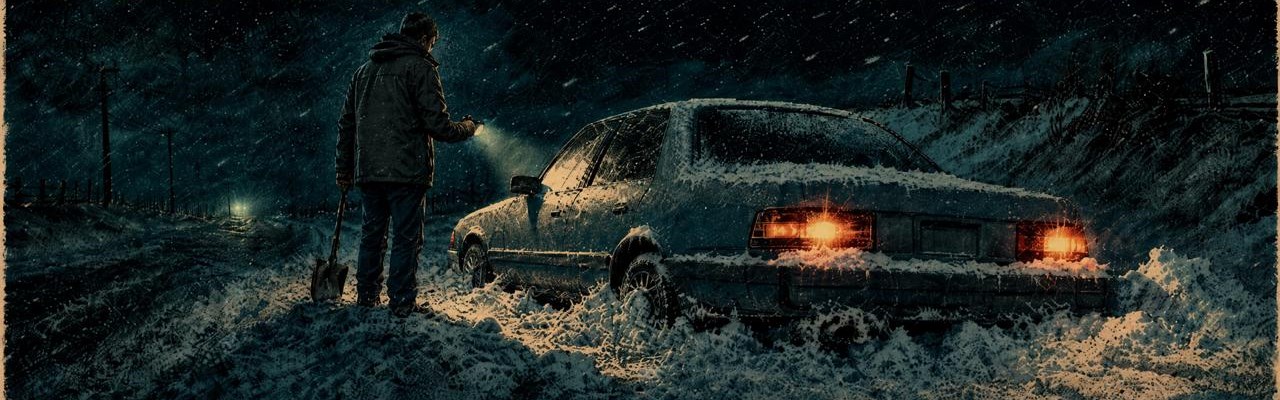
The situation
Getting stuck in snow or mud is one of the most common roadside emergencies in the winter months and shoulder seasons. According to AAA, hundreds of thousands of drivers call for a tow every year because they're stuck. The main mistake is trying to power out by spinning the wheels, which only makes things worse: the snow gets packed into ice, the car sinks deeper, and you can overheat the transmission. Another danger is carbon monoxide: if the exhaust pipe is plugged with snow and the engine is running, CO seeps into the cabin (an odorless gas, lethal). A third threat is hypothermia: at temperatures below -7°C (19°F) with wind, hypothermia can set in within less than an hour.
Step-by-step actions
- 1Stop giving it gas immediately — if the drive wheels are spinning freely, take your foot off the pedal right away (spinning turns snow into ice and digs the car in deeper).
- 2Turn on your hazards — if you're stuck on a busy road, so other drivers see the car from a distance.
- 3Assess the safety of the spot — if you're on a highway or open stretch: stay buckled in, call for a professional tow, and don't try to free the car yourself (danger from passing traffic).
- 4Check the exhaust pipe — get out of the car and make sure the pipe isn't plugged with snow or mud (if it's plugged and you start the engine for heat, carbon monoxide will flow into the cabin and kill you in 10-15 minutes, with no smell and no symptoms).
- 5Clear the snow around the drive wheels — with a shovel or your hands, clear the snow for 0.6-0.9 meters (2-3 feet) in front of AND behind the drive wheels (front on a FWD, rear on a RWD, all four on AWD/4WD), plus clear the snow from under the car's belly so nothing catches.
- 6Create traction under the wheels — scatter sand, salt, cat litter, or gravel under the drive wheels, or stuff in the floor mats from the cabin (rubber or fabric doesn't matter — the point is for the wheels to grip something solid instead of slick snow).
- 7Turn off traction control temporarily (if there's a button) — the system blocks wheelspin, but a controlled little bit of spin helps clear the ice from under the wheels.
- 8Straighten the wheels — turn the steering wheel so the wheels point straight ahead (any angle creates extra rolling resistance).
- 9Put it in Drive (or second gear on a manual) — not first: second delivers less torque = less chance of spinning.
- 10Press the gas gently — don't floor it; press smoothly so the car starts to move slowly (if the wheels start to spin, take your foot off immediately).
- 11Rock the car — if it won't move forward, shift to Reverse, gently give it gas backward, then back to Drive forward, then Reverse — the cycle builds momentum and the car "rolls out" (WARNING: some automatics' manuals state a limit on these cycles to avoid overheating the transmission — check the owner's manual before rocking).
- 12If you have helpers — ask them to push the car from the front corners or rear bumper (not the sides, so the car doesn't suddenly shoot sideways) in sync with the rocking.
- 13Last resort — let air out of the tires — deflate the tires to ~1.5 atmospheres (instead of the usual 2-2.5) to enlarge the contact patch with the surface (but reinflate at the nearest gas station right after you get out — you can't drive on deflated tires for more than a couple of kilometers).
- 14If nothing worked — call AAA or a tow truck — they'll come with a winch and pull you out (AAA number: 1-800-222-4357).
A real case: why this way and not another
The mechanics of getting stuck
Why is spinning the wheels worse? When a wheel spins on snow, friction generates heat. The bottom layer of snow under the wheel melts, the water turns to ice in below-freezing temperatures, and you get a smooth icy crust. The coefficient of friction of rubber on ice is 4-5 times lower than on snow. Plus a wheel that spins without traction doesn't roll, it "digs" — snow flies out backward from under the wheel, the car settles down, and the belly grounds out on the snow. The result: the longer you spin, the deeper you get stuck.
Rocking works through momentum. When the car moves forward even by 10 cm, it builds momentum. If you quickly shift to Reverse and give it gas while the car is still moving forward, that momentum adds to the rearward traction = the car rolls back farther. Then forward again — and over a few cycles the amplitude of motion grows, like pumping a swing.
If you have to wait a long time for help (Remote Area Survival)
- 1Stay with the car, don't set off on foot — a car is 100 times more noticeable to searchers than a person, plus the car = shelter from wind and cold.
- 2Run the engine for heat no longer than 10-15 minutes per hour — so you don't burn through all the fuel and so snow doesn't plug the exhaust again (check the pipe each time before starting).
- 3Put a bright cloth on the antenna or mirror — a signal for rescuers.
- 4Use blankets, floor mats, and newspapers for insulation — put them under you (cold comes from below) and cover up on top.
- 5Don't eat snow — it uses your body heat to melt it and can cause hypothermia from the inside; better to melt the snow in your mouth and then swallow the water.
- 6Move around inside the car every 15-20 minutes — clench/unclench your toes and fingers so blood circulates and your extremities don't get frostbitten.
How it develops: what's important to understand
Your rights
The right to call for help and stay in the car. You're not obligated to crawl under the car and dig it out in dangerous conditions — you may stay buckled and wait for a tow, especially on a highway.
The right to a winch-out under your roadside plan. If you have AAA or roadside assistance on your policy, winching is usually part of the plan — ask the dispatcher what's covered.
The right to a quote before the tow. You may ask the price up front and decline a private tow's inflated "recovery/storage" fee; you can call another.
The right to call 911 in a life threat. A risk of hypothermia or carbon monoxide, or blocking a highway lane, is grounds for 911 even if you're formally "just stuck."
Phone numbers
— AAA 1-800-222-4357 (1-800-AAA-HELP) — winching/extrication if you're stuck on the shoulder within reach of the road (included in most AAA plans).
— 911 — only if you're stuck in a travel lane on the highway and creating a hazard to traffic, or a medical emergency.
— State highway patrol non-emergency — if you're on a freeway and AAA is unavailable.
What to say
- To the AAA dispatcher: "I'm stuck in snow/mud on [road name, direction, mile marker, or nearest exit]. The car is a [year/make/model]. I'm on a [residential street / highway shoulder / parking lot — state accessibility for a tow truck]. I need a winching service."
What NOT to say/do
- "Let me just give it one more shot of gas" — if you've already spun for 10-15 seconds and it didn't help, more spinning will only make it worse.
- Don't shut the engine off completely in the cold — if the battery is old, the car may not start again; better to warm it up periodically.
- Don't pour water/hot water on the snow under the wheels — the water freezes immediately and makes the ice even slicker.
- Don't push the car from the doors or the side — if the car breaks loose, it can crush the person pushing.
Specific situations
Life hacks
- 1Always keep a winter emergency kit in the trunk: a folding shovel, a 5-10 kg bag of sand/salt, a tow strap, a couple of old floor mats (or dedicated traction mats for $30-50), a blanket, a flashlight, gloves, a candle in a can (gives heat in a closed car), energy bars, water.
- 2Cabin floor mats = free traction mats — stuff rubber or fabric floor mats under the drive wheels; they give traction just as well as dedicated $50 mats.
- 3Don't let the tank drop below half in winter — if you get stuck, fuel = a source of heat; plus a full tank = less condensation in the tank = less risk of the fuel line freezing.
- 4Winter tires with the Three-Peak Mountain Snowflake (3PMSF) symbol — 30-40% better traction on snow and ice than all-seasons; in some states (CA, NV, OR, WA, CO), mountain passes in winter require chains or 3PMSF tires.
- 5Before driving onto a snowy road — build up speed — it's easier to keep momentum on snow than to start from a standstill; if you see a snowy stretch ahead, accelerate on clean pavement to "shoot through" the snowy stretch with a running start.
- 6Leave one car's worth of space ahead of you at traffic lights in winter — if the car in front of you can't get going on the snow, you have room to maneuver around it.
- 7Carry tall boots and a warm jacket in the car — even if you don't plan to get out; if you get stuck, you'll have to get out and dig snow, and in office shoes and a blazer you'll freeze instantly.
- 8A candle in a glass jar — if you're stuck for a long time with no fuel, a single candle can raise the temperature in a sealed car by 5-10 degrees over an hour (plus it's psychologically reassuring).
- 9Deflated tires in winter are normal off-road — pros in snowy regions deliberately drop the pressure to 1.2-1.5 atm before going onto deep snow, then reinflate on pavement; a wide contact patch = you sink in less.
- 10A GPS tracker or Garmin inReach for frequent trips through remote areas — if you're stuck in the woods with no cell signal, a satellite tracker for $150-300 with a $12-50/month subscription will send your SOS coordinates to rescuers even from deep in the forest.
Key facts
- Wheelspin turns the snow under the tire into ice, and rubber-on-ice friction is 4–5 times lower than on snow.
- A snow-plugged exhaust with the engine running pushes carbon monoxide (CO) into the cabin — death in 10–15 minutes with no smell and no symptoms.
- CO binds to hemoglobin roughly 200 times more effectively than oxygen.
- At temperatures below -7°C (19°F) with wind, hypothermia can set in within less than an hour.
- Staying with the car is safer: it's 100 times more noticeable to searchers than a person and serves as shelter.
- AAA (1-800-222-4357) winches a stuck car out; the service is included in most plans.
Test yourself
- a) Give it even more gas
- b) Take your foot off the pedal right away
- c) Crank the wheel hard
- d) Drop into first and floor it
- a) The oil level
- b) That the exhaust pipe isn't plugged with snow
- c) The tire pressure
- d) The radio
- a) Set off on foot for help
- b) Stay with the car
- c) Walk only at night
- d) Walk if it's cold
- a) First, for maximum torque
- b) Drive or second — less torque, less wheelspin
- c) Reverse at full throttle
- d) Neutral
- a) Yes, it melts the snow
- b) No — the water refreezes and makes the ice slicker
- c) Only boiling water
- d) Only on the front wheels
- a) Continuously, to stay warm
- b) 10–15 minutes per hour, checking the exhaust each time
- c) Only at max revs
- d) Don't run it at all
Answers and explanations
You ran out of gas on the road
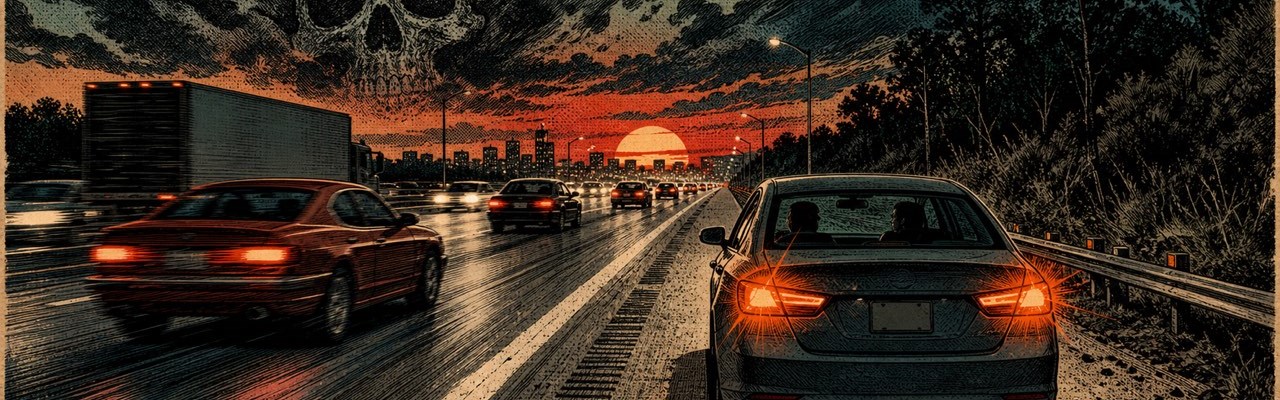
The situation
Running out of gas is one of the most common reasons for a roadside assistance call in the U.S.: from January to April 2019 alone, AAA handled 205,549 calls for this reason. The situation seems trivial, but on a highway it's deadly: trying to walk to a gas station kills dozens of people every year (struck by passing cars at 100+ km/h). The second danger is fuel pump damage: if you keep pressing the gas when the tank is empty, the electric pump inside the tank overheats without fuel to cool it, and repairs run $500-800. The third problem is air and sediment getting into the fuel system if you crank the starter on an empty tank.
Step-by-step actions
- 1As soon as you feel a loss of power (the car jerks, won't accelerate) — turn on your hazards immediately to warn drivers behind you.
- 2Use the remaining momentum — don't brake hard; coast smoothly onto the shoulder as far right as possible (use the last meters of motion to reach the widest part of the shoulder or an exit).
- 3Shift to Park, set the parking brake — secure the car so it doesn't roll.
- 4Stay inside the car with your seatbelt on (especially on a busy highway) — your car = protection from traffic passing at speed; getting out = the risk of being hit.
- 5Pin down your exact location:
— Highway: note the mile marker (the white markers every mile along the road), the exit number, the direction of travel (N/S/E/W)
— Use the GPS on your phone for coordinates
— Nearby landmarks (a bridge, a sign, the name of a business on the shoulder) - 6Call for fuel delivery (in order of priority):
— AAA 1-800-222-4357 — they bring gas right to your spot (AAA members: delivery is included, fuel ~$5-10 on top)
— Roadside assistance through your auto insurance (if you have this option in your policy)
— Mach1 app or a similar service — on-demand fuel delivery without a membership (you pay per trip: ~$50-100 + fuel)
— Friends/family — ask them to bring 1-2 gallons in an approved gas can (not in a plastic water bottle — it will melt) - 7If you're in a remote area with no cell signal:
— Stay with the car (a car is more visible to rescuers than a lone person)
— Set out reflective triangles 30 meters (100 feet) behind the car, if you have them
— Hang a white cloth on the antenna/mirror as a distress signal
— Conserve your phone battery for emergency calls - 8NEVER walk for gas on a highway — AAA and every state DOT categorically forbid it: the risk of being struck at 100+ km/h is too high.
- 9After refueling, do NOT pump the gas pedal repeatedly when trying to start the car — it can damage the fuel pump; one normal start should do it.
A real case: why this way and not another
How fuel pump damage happens
Modern cars have an electric fuel pump inside the tank. Gasoline serves two functions: fuel AND coolant for the pump. When the tank is empty and you keep cranking the starter or pressing the gas (trying to "squeeze out the last drops"), the pump runs dry and overheats without cooling. The windings inside the pump's motor can burn out. Replacing the fuel pump: $400-800 depending on the model (pump $200-400 + labor $200-400). According to AAA and American Auto Insurance, modern cars are better protected than older ones — when fuel pressure drops, the ECU (engine computer) shuts off the ignition system automatically to prevent damage. BUT repeated attempts to "suck out" the last of the gas shorten the pump's lifespan and can cause a failure a few weeks later.
Diesel engines are especially vulnerable: if a diesel runs completely dry, air gets into the fuel system. A diesel system operates at a far higher pressure than a gasoline one, and air in the lines = the engine won't start even after refueling. It requires professional purging of the system — costing $150-300.
How it develops: what's important to understand
Your rights
The right to fuel delivery under your membership or policy. For AAA members and with a roadside assistance option, fuel delivery is usually included — they bring 1–2 gallons to reach the nearest station.
The right to stay in the car and call for help. You're not obligated to rescue the situation yourself on a dangerous shoulder — stay buckled and wait for help, especially on a highway.
The right to decline a stranger's ride. While you wait, someone may offer a lift — you may politely decline and wait for the help you called.
The right to know the price before the service. You may ask the delivery or tow price up front and decline a private operator's inflated bill.
Phone numbers
— AAA 1-800-222-4357 — fuel delivery is included in your membership (they bring 1-2 gallons, enough to reach the nearest station; the fuel usually costs $5-10 over market price)
— Mach1 or other app-based services — download the app, order fuel delivery, pay for delivery + fuel (no membership)
— State highway patrol non-emergency — if you're on a freeway and AAA/roadside is unavailable
— 911 ONLY if: you're in an unsafe spot (the car is in a travel lane and not moving) OR a medical emergency
What to say
- To the AAA dispatcher: "I ran out of gas on [highway/road name, direction, mile marker, or nearest exit]. The car is on the shoulder at [GPS coordinates or description]. I need fuel delivery. Regular unleaded / Diesel" (state the fuel type).
What NOT to say/do
- "I'll just walk to the gas station" — on a highway that's suicide; even on a regular road, walking 3-5 km with a gas can = danger (no sidewalk, cars close by).
- Don't accept rides from strangers — while you wait for help, someone may offer a lift; that's a risk (carjacking, assault).
- Don't leave the car on the highway longer than necessary — in some states an abandoned vehicle gets towed after 24-48 hours, and you'll have to pay impound fees.
- Don't pump the gas pedal on restart — one start with normal pedal pressure; if it doesn't start, wait 10 seconds and try again; repeated pumping floods the engine and harms the pump.
Specific situations
Life hacks
- 1Always keep the tank at least 1/4 full (an AAA recommendation) — a reserve for the unexpected: detours, traffic jams, stations closed at night.
- 2Reset the trip odometer to zero after every fill-up — track how many km you've driven; when you reach 80% of your usual range on a tank, start looking for a station, don't wait for the warning light.
- 3Don't trust the fuel gauge on older cars (10+ years) — the sensors wear out and can read wrong; count miles since your last fill-up.
- 4In winter keep the tank at least half full — condensation in a half-empty tank freezes in the fuel line during a hard freeze; a full tank = less air = less condensation.
- 5AAA Basic membership is $56-70/year — it pays for itself in a single call (fuel delivery without a membership is $50-100 + fuel); Plus/Premier give more benefits (longer towing distance, lockout coverage).
- 6Download Mach1, Honk, or a similar app ahead of time — when you're out of gas is no time to register in an app on the shoulder; install it in advance and save a payment method.
- 7The warning light comes on when 10-15% of the tank is left — that's usually 50-80 km of range in a regular car, 30-50 km in an SUV/truck; you have time, but don't put it off.
- 8If you're driving into a remote area (desert, mountains, forest) — fill up to the brim before you go and keep a 5-gallon jerry can of gas in the trunk (in a metal or approved plastic can, not a bottle).
- 9GPS shows gas stations — in Google Maps/Waze/Apple Maps, search "gas station near me"; you can see prices, hours, reviews; pick a station that's definitely open.
- 10If you do have to walk (not on a highway!) — take a gas can (approved container), your phone, a reflective vest (if you have one), and walk AGAINST the flow of traffic so you can see oncoming cars.
Key facts
- From January to April 2019 alone, AAA handled 205,549 out-of-fuel calls.
- Walking a highway shoulder for gas is deadly: a shoulder is not a sidewalk, and there's no protection there.
- Running dry can burn out the in-tank electric pump (the fuel cools it); the repair is $400–800.
- A diesel left without fuel lets air into the lines — it needs a professional purge ($150–300).
- The warning light comes on at 10–15% of the tank — usually 50–80 km of range in a car.
- Fuel delivery (AAA or an app) is cheaper than a pump repair or a hospital bill.
Test yourself
- a) Brake hard in your lane
- b) Turn on hazards and coast right onto the shoulder
- c) Give it more gas
- d) Turn back around
- a) Yes, faster to walk
- b) No, stay in the car and call for delivery
- c) Walk on the median
- d) Hitch a ride
- a) Yes, pump it hard
- b) No — one normal start; pumping harms the pump
- c) Crank the starter nonstop
- d) Push it down a hill
- a) 911
- b) AAA / roadside / a fuel-delivery app
- c) Tow trucks don't come for out-of-gas
- d) None
- a) A plastic water bottle
- b) An approved gas can
- c) A bucket
- d) Any container
- a) Starts right up
- b) May not start — air in the lines, needs a purge
- c) Never starts again
- d) Only starts on a tow
Answers and explanations
Flat tire on the highway
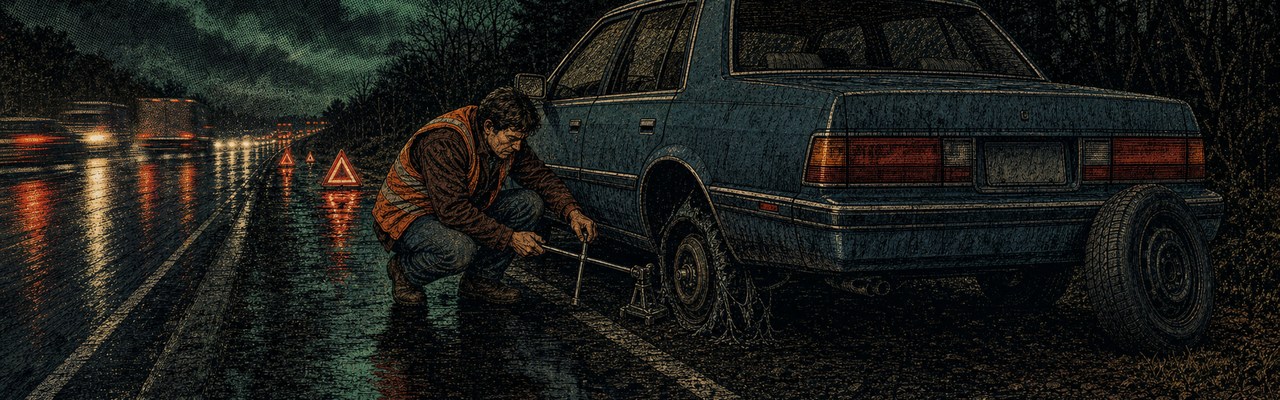
The situation
A flat tire on the highway is one of the most dangerous roadside emergencies: according to NHTSA and various state highway patrols, dozens of people die every year while changing a tire on the shoulder (struck by cars passing at 60+ mph). AAA handles millions of flat-tire calls every year. The main danger isn't the flat itself, but trying to change the tire in traffic: a narrow shoulder, cars whizzing by a few feet away, the jack can slip, the lug nuts may not budge. The second danger is a sudden blowout at speed: the car can spin or be thrown into oncoming traffic if you react the wrong way.
What it costs (if you react the wrong way)
A blowout at speed with the wrong reaction = loss of control = a crash. The most common mistake is hard braking or a sharp turn of the wheel when a tire blows. That shifts the car's weight unevenly onto the remaining three wheels, spinning the car or throwing it sideways.
Trying to change it on a busy highway = risk of getting hit. Even professional roadside technicians die on the highway — drivers get distracted by phones and ignore the "Move Over Law" (the requirement to clear the adjacent lane when they see a stopped vehicle).
Step-by-step actions
If it's a SLOW leak (the tire is deflating gradually)
- 1Assess the safety of your current spot — if you're on the highway in heavy traffic, it's better to drive 1-2 km on the flat to a safe place (parking lot, rest area, wide shoulder) than to change it right here.
- 2Turn on the hazard lights — the moment you notice the problem.
- 3Find a safe place to stop (in order of priority):
— A parking lot of a gas station, restaurant, or business
— A rest area or scenic overlook
— A wide shoulder away from traffic
— NOT a narrow highway shoulder in heavy traffic - 4Pull fully onto the shoulder — as far right as possible, so the car is as far as it can be from passing vehicles.
- 5Shift to Park, set the parking brake — secure the car (it must not move while on the jack).
- 6Set out warning triangles or flares — 100-300 feet (30-100 meters) behind the car to warn drivers in advance.
- 7Assess the situation:
— If it's a highway with heavy traffic, a narrow shoulder, or bad weather → do NOT try to change it yourself → stay in the car with your seatbelt on → call AAA 1-800-222-4357 or roadside assistance
— If it's a safe spot (parking lot, wide shoulder, light traffic, daytime, good visibility) → you can try to change it yourself
Tire-change procedure (if it's safe)
- 8Get the tools out of the trunk: spare tire (full-size or donut), jack, lug wrench, wheel chocks (if you don't have them, a brick, rock, or piece of wood will do).
- 9Wheel chocks — place them under the wheel diagonally opposite the flat (if the flat is front-left → chock the rear-right), so the car can't roll.
- 10Loosen the lug nuts WHILE THE CAR IS ON THE GROUND — while the wheel is on the ground and the car is stable, loosen the nuts a half-turn (do NOT remove them fully). Order: crisscross (top first, then the one opposite at the bottom, then left, then the one opposite on the right) — this prevents misalignment.
- 11Place the jack under the car's frame — find the jack point (listed in the owner's manual — usually a reinforced point under the body near the wheel), NOT under a plastic body panel.
- 12Raise the jack — lift the car so the flat tire hangs 10-15 cm (4-6 in) off the ground (no higher — the higher it is, the less stable it is).
- 13Remove the lug nuts completely — put them somewhere safe (in the hubcap or on the floor mat so they don't roll away).
- 14Take off the flat, mount the spare — carefully remove the wheel (it's heavy, 10-15 kg), put the spare on the bolts, and line up the holes.
- 15Hand-tighten the lug nuts crisscross — first hand-tighten all the nuts (to seat the wheel), then snug them with the wrench slightly (NOT all the way while the wheel is in the air).
- 16Lower the jack — bring the car fully down to the ground.
- 17Tighten the lug nuts fully — now that the car is on the ground, tighten the nuts crisscross with force (about 100 ft-lbs of torque — but by hand without a torque wrench, just pull hard, don't stand on the wrench).
- 18Put away the tools, flat in the trunk — pack everything back up.
- 19Drive carefully — if you put on a donut (compact spare), the speed limit is usually 50 mph (80 km/h) and the range is 50-70 miles (80-110 km); a donut is NOT a full-size wheel, it's thinner and smaller in diameter.
- 20Take the flat to a tire shop as soon as possible — check whether it's repairable (if the puncture is in the tread and smaller than 6 mm — usually repaired for $15-30; if it's in the sidewall or larger than 6 mm — replacement only).
If it's a sudden BLOWOUT (a tire exploding at speed)
- 1Do NOT brake hard, do NOT turn the wheel sharply — this is critical: hard braking shifts weight forward, the rear end can spin out; a sharp turn can throw the car into oncoming traffic.
- 2Grip the wheel firmly with both hands — the car will pull toward the blown tire (if it's the front-left, it pulls left); you have to hold your line by muscle effort.
- 3Take your foot off the gas — ease off the pedal smoothly (do NOT hit the brake), and let the car slow naturally through air resistance and rolling drag.
- 4Steer gently toward the shoulder — with small steering corrections, guide the car toward the right shoulder, without any sharp maneuvers.
- 5Brake only once your speed has dropped to 30-40 mph — once the car has slowed naturally, you can start braking gently.
- 6Pull fully onto the shoulder, turn on the hazards — stop and follow the procedure above.
A real case: why it has to be this way and not another
The mechanics of a blowout
Why does hard braking = a spin? When driving at speed, the car's weight is distributed roughly evenly across the four wheels (with a slight forward bias due to the engine). When you brake hard, inertia shifts the weight onto the front wheels (the front suspension compresses, the rear unloads). If one front tire has already gone flat, the two front wheels brake unevenly (one grips, the other slides), and the car spins around the wheel braking harder. Plus the unloaded rear axle loses traction and easily breaks into a skid.
Why does a blowout pull to one side? A flat tire has a much smaller diameter (the tread has collapsed onto the rim), plus a higher rolling-resistance coefficient. This creates asymmetric drag: one side of the car is slowed more, the other keeps rolling — and the car veers toward the blown tire. Your job is to hold the wheel straight by muscle effort until the car slows down.
How it develops: what's important to understand
Phone numbers
— AAA 1-800-222-4357 — tire change service is included in most membership plans (they come and change it on the spot; if they can't safely change it on the highway, they tow you to a tire shop)
— Roadside assistance through your auto insurance — check whether it's in your policy
— 911 — only if the blowout caused a crash or the car is in an unsafe spot (in a travel lane, on railroad tracks, etc.)
Your rights
You have the right to call AAA even if you're on a toll road or in a tunnel — they will come (though there may be restrictions in some tunnels for ventilation and safety reasons).
What to say
- To the AAA dispatcher: "I have a flat tire on [highway name, direction, mile marker or exit]. The car is in [a parking lot / on a wide shoulder / on a narrow shoulder]. [Year/make/model]. I need a tire change or a tow to a tire shop."
- If the blowout caused a crash: "Crash at [location] caused by a tire blowout. [Number] of cars. [Injuries yes/no]."
What NOT to say/do
- "I'll just change it myself quickly on the highway" — if traffic is heavy and the shoulder is narrow, the risk of getting hit is too high; AAA will be there in 30-40 minutes and do it more safely.
- Don't try to change a tire at night on the highway without a reflective vest — visibility is almost zero, drivers don't see you until the last second.
- Don't rely on the hazard lights alone — setting out warning triangles/flares is a must; hazard lights are only visible once a car is already close.
- Don't drive a donut faster than 50 mph or farther than 50-70 miles — a donut isn't built for long-distance driving and can overheat and blow.
Specific situations
Tips & tricks
- 1Check your tire pressure once a month — underinflated tires overheat and can blow; overinflated ones lose grip and puncture more easily (AAA: 28% of drivers drive on underinflated tires).
- 2Minimum tread depth of 2/32 inch (1.6 mm) — stick a penny in the tread with Lincoln's head down: if you can see all of Lincoln's head, the tire is worn out — replace it.
- 3Rotate tires every 5,000-7,500 miles — even wear extends their life and lowers the risk of a blowout.
- 4The spare MUST be inflated — check the spare's pressure every 3-6 months; many people discover a flat spare only when they need it.
- 5Always keep in the trunk: a reflective vest (orange/yellow), a flashlight, gloves, warning triangles, wheel chocks.
- 6Run-flat tires — if you drive the highway often, consider run-flat tires (you can drive 50 miles at up to 50 mph after a puncture); pricier than regular ones ($150-200 vs. $100-150), but you'll reach a tire shop without changing the tire.
- 7Tire pressure monitoring system (TPMS) — all 2008+ cars have TPMS by law; if the TPMS light comes on, check your pressure right away (don't wait until it goes fully flat).
- 8Always tighten lug nuts crisscross — if you tighten them in a circle, the wheel will sit crooked and can come loose while driving; crisscross distributes the pressure evenly.
- 9After changing a tire, in 50-100 miles — stop by a tire shop and ask them to check the lug-nut torque (they can loosen after settling).
- 10Never stand/work between the car and traffic — always on the far side of the car (the car = a shield between you and passing vehicles); if you get hit, it'll be from the back, not head-on.
- 11A spare tire (donut) is NOT for permanent driving — a donut is a temporary measure: narrow, light, not rated for full load; get the flat to a tire shop within 1-2 days.
- 12If you're not confident in your abilities — don't try — a stuck/tilted jack, stripped lug nuts, a car that rolled off — these are more dangerous than waiting 30 minutes for AAA.
Key facts
- Dozens of people die every year changing a tire on the shoulder — in the statistics it's "pedestrian struck on highway."
- During a blowout, don't brake hard or turn — hold the wheel straight, take your foot off the gas, let it slow.
- Loosen the lug nuts on the ground, and tighten them crisscross (about 100 ft-lbs) after lowering the jack.
- A donut is rated for about 50 mph and 50–70 miles of range — it's not a full-size wheel.
- All cars from 2008 on are legally equipped with a tire pressure monitoring system (TPMS).
- AAA includes a tire change in most plans; work from the side of the car away from traffic.
Test yourself
- a) Slam the brakes and swerve
- b) Hold the wheel straight, take your foot off the gas, let it slow
- c) Jerk toward the shoulder
- d) Give it gas to straighten out
- a) Once the wheel is raised
- b) On the ground, before jacking
- c) After removing the wheel
- d) It doesn't matter when
- a) Change it yourself quickly
- b) Stay in the car and call AAA
- c) Change it from the traffic side
- d) Push the car farther
- a) Same as a regular wheel
- b) About 50 mph and 50–70 miles
- c) No limits in the city
- d) Highway only
- a) The traffic side
- b) The side away from traffic
- c) The front
- d) It doesn't matter
- a) Yes, right on the spot
- b) No, drive to a safe place first
- c) Drive until it bursts
- d) Stop in a travel lane
Answers and explanations
Engine overheated
The situation
Engine overheating is a critical failure that can lead to a complete engine breakdown costing $3,000-8,000+ to repair or replace. According to AAA, overheating is one of the top-5 causes of roadside breakdowns. The main causes: a coolant leak, a failed thermostat, a broken water pump, a clogged radiator, a torn fan belt. The main danger is continuing to drive on an overheated engine: above 240-250°F (115-120°C) the metal expands, the pistons seize in the cylinders, the head gasket blows, the engine block cracks. All of that = catastrophic engine failure.
Step-by-step actions
If the temperature gauge shows overheating or the red warning light comes on
- 1Turn off the A/C immediately — the A/C puts extra load on the engine and cooling system (it draws power through the compressor on the belt).
- 2Turn the heater to maximum — it sounds paradoxical, but the heater draws heat out of the engine's cooling system and dissipates it into the cabin; this is temporary cooling for the engine (the cabin will get hot, but the engine cools down by 5-10 degrees).
- 3If stuck in traffic / at a light — shift to Neutral or Park and rev the engine — slightly raising the rpm to 1500-2000 speeds up coolant circulation through the system and spins the fan faster (this only helps if there's still coolant in the system).
- 4Turn on the hazards and look for a safe place to stop — a parking lot, shoulder, exit.
- 5DO NOT KEEP DRIVING — if the temperature is in the red zone (above 240°F / 115°C) or the red light is on, every minute of driving brings the engine closer to seizing.
- 6Pull onto the shoulder, shut off the engine — come to a complete stop, shift to Park, turn off the ignition.
- 7DO NOT OPEN THE HOOD right away — there may be pressurized steam under the hood; let it cool for 15-20 minutes minimum.
- 8DO NOT OPEN THE RADIATOR CAP while it's hot — the cooling system is pressurized to 15-20 PSI; opening the cap on a hot engine sends boiling coolant shooting out in a geyser and can cause third-degree burns to the face and hands (the coolant temperature can be 250°F / 120°C).
- 9Wait at least 30 minutes until it cools down completely — the engine should cool to room temperature; you can carefully touch the hood with your hand: if it's still hot, wait longer.
- 10After cooling: open the hood and check the coolant level — find the overflow reservoir (usually a translucent plastic tank labeled "Engine Coolant" or marked with a thermometer symbol), check that the level is between the MIN and MAX marks.
- 11If the level is low — top up with water or coolant:
— If you have coolant (50/50 antifreeze/water mix) — add it
— If not — you can temporarily add plain water from a bottle (not ideal, but better than nothing; you'll need to flush the system and add proper coolant later)
— Pour SLOWLY, to avoid thermal shock (cold water into a hot engine can crack the block) - 12Visually check for leaks:
— Puddles under the car (green, orange, or pink fluid = coolant)
— Radiator hoses (cracks, ruptures)
— The radiator itself (holes, corrosion) - 13Try to start it and drive a short distance — if you added coolant, start the engine, let it idle for 2-3 minutes, and watch the temperature.
- 14If the temperature climbs again — DO NOT DRIVE — call a tow truck (AAA 1-800-222-4357). Continuing to drive = guaranteed engine death.
- 15If the temperature has stabilized — you can carefully drive to the nearest mechanic — drive slowly (40-50 mph max), watch the gauge every 30 seconds, heater on max, A/C off.
If steam is pouring out from under the hood
- 1Pull onto the shoulder IMMEDIATELY and shut off the engine — steam = critical overheating, the system is boiling, a pressurized leak is possible.
- 2DO NOT OPEN THE HOOD until the steam stops completely — you can get serious burns.
- 3Wait at least 45 minutes — let the system cool and relieve the pressure.
- 4After cooling: check the coolant level and for leaks — but do NOT try to drive any farther; call a tow truck.
A real case: why it has to be this way and not another
The mechanics of overheating
Why does turning on the heater help? The heater core is a miniature radiator under the dashboard that hot coolant passes through. When you turn on the heater, the cabin fan blows air through the heater core, cooling the coolant. The cooled coolant returns to the engine. This is an additional heat-dissipation path besides the main radiator. The effect is a 5-15°F (3-8°C) drop, which can be critical for avoiding the catastrophic-overheating zone.
Why does revving the engine help? The water pump is driven by a belt off the engine. Higher rpm = the pump spins faster = coolant circulates faster through the engine and radiator. BUT this only works if there's enough coolant in the system. If the leak is large and there's almost no coolant left, revving won't do anything and can make it worse (more friction = more heat).
How it develops: what's important to understand
Your rights
The right to a tow under your membership or policy. For AAA members and with a roadside assistance option, a tow to a mechanic is usually included — don't risk the engine to save on a tow.
The right not to drive any farther. No one can force you to drive a failing car; refusing to drive an overheated engine is the safe, sensible call.
The right to an estimate and diagnosis before repairs. You may get a written estimate and a diagnosis before work begins, and for an expensive diagnosis (engine, head gasket) get a second opinion.
The right to know the cause and keep the old parts. Ask the mechanic to show you the failed part; in many states you're entitled to keep the parts they removed.
Phone numbers
— AAA 1-800-222-4357 — tow to a mechanic
— Roadside assistance through your insurance — if it's in your policy
— 911 — only if the overheating caused a fire under the hood or you've blocked the highway
What to say
- To the AAA dispatcher: "My engine overheated at [location]. The car has cooled down, but the coolant leaked out / the temperature is rising again. I need a tow to the nearest auto shop. [Year/make/model]."
- To the mechanic: "The engine overheated on the highway. I stopped right away / I kept driving [X miles]. The temperature was [in the red zone / a bit above normal]. I saw steam / didn't see steam. The coolant level was [low / normal]. I didn't see any leaks / saw a puddle under the car."
What NOT to say/do
- "I'll make it home, then I'll deal with it" — every minute of driving an overheated engine can cost thousands of dollars in repairs.
- Don't pour cold water into a hot engine quickly — thermal shock can crack the block; pour slowly, in a thin stream.
- Don't ignore the warning signs before overheating — a strange sweet smell from the vents (the smell of coolant), the temperature above the middle of the gauge, a trail of steam behind the car — these are signs of a developing problem.
- NEVER open the radiator cap on a hot engine — third-degree burns in a second.
Specific situations
Tips & tricks
- 1Check the coolant level once a month — open the hood on a cold engine, look at the overflow reservoir, the level should be between MIN and MAX.
- 2Change the coolant every 30,000-50,000 miles or every 3-5 years (depends on the coolant type: green is changed more often, orange extended-life less often).
- 3Warning signs of impending overheating:
— The temperature gauge creeping above the middle
— A sweetish smell from the vents (the smell of antifreeze)
— White steam from the exhaust pipe (coolant getting into the combustion chamber = a blown head gasket)
— A puddle of green/orange/pink fluid under the car in the morning - 4Coolant + water 50/50 is the optimal mix — pure antifreeze without water cools WORSE than the mix; water is the better heat-transfer fluid, antifreeze prevents freezing in winter and corrosion year-round.
- 5In summer heat, watch the temperature more closely — in traffic in 100°F+ (38°C+) heat, the engine has a harder time shedding heat, especially with the A/C on.
- 6The thermostat is a common cause of overheating — costs $15-40, replacement $100-200; if the thermostat sticks closed, the coolant doesn't circulate through the radiator.
- 7A water pump lasts 60,000-90,000 miles — signs of wear: a strange whine/grinding from under the hood, a coolant leak from under the pump.
- 8A pressure test of the cooling system — if you suspect a slow leak but can't see it, a mechanic can pressurize the system and find the source (costs $50-100).
- 9Don't mix different types of coolant — green (traditional), orange (Dex-Cool), pink/purple (Asian/European) have different additives; mixing them can cause a chemical reaction and gel formation.
- 10Carry a gallon of water in the trunk — if the coolant leaks out far from civilization, water will let you reach the nearest auto shop (then drain it and add the proper coolant).
- 11Visual inspection of the radiator hoses — every 6 months, squeeze the hoses by hand on a cold engine: if they're hard/cracked/bulging, it's time to replace them (hoses cost $20-50, the replacement is easy).
- 12If the head gasket has blown — signs: white smoke from the exhaust, bubbles in the overflow reservoir while the engine runs, oil in the coolant (brownish sludge in the reservoir), coolant in the oil (white emulsion on the dipstick); repair $1,000-2,500.
Key facts
- Above 240–250°F (115–120°C) the metal expands, the pistons seize, and the block cracks — catastrophic failure.
- The cooling system is pressurized to 15–20 PSI; opening the cap while hot sprays boiling fluid and causes burns.
- The heater on max pulls heat from the engine into the cabin — it buys time until you stop.
- Proper coolant is a 50/50 antifreeze/water mix; pure antifreeze cools worse.
- Overheating is one of the top-5 causes of roadside breakdowns, according to AAA.
- Stopping right away (a $200–500 hose/thermostat) is cheaper than driving on (a $3,000–8,000+ engine).
Test yourself
- a) Yes, it's not far
- b) No, pull over and shut off immediately
- c) Drive faster for airflow
- d) Drive with the windows down
- a) Turn on the A/C
- b) Turn the heater to max
- c) Shut off and open the radiator right away
- d) Floor the gas
- a) Yes, to cool it faster
- b) No, wait ~30 minutes — it's boiling fluid under pressure
- c) Yes, with a glove
- d) Yes, crack it with a rag
- a) Fast and a lot
- b) Slowly, and better once cooled, so the block doesn't crack
- c) Only boiling water
- d) Through the exhaust
- a) Pure antifreeze
- b) A 50/50 antifreeze and water mix
- c) Water only
- d) Oil and water
- a) Drive on carefully
- b) Don't drive, call a tow
- c) Keep topping up while moving
- d) Shut off and restart a few times
Answers and explanations
Brakes failed
The situation
Brake failure is one of the most terrifying roadside emergencies: the pedal sinks to the floor, the car doesn't brake, the speed doesn't drop. According to NHTSA and various mechanics, total brake failure is rare in modern cars (a dual braking system: independent circuits for the front and rear brakes), but it does happen due to: a brake fluid leak, a ruptured brake line, air getting into the system, brakes overheating on long descents. The main danger is panic: a panicked driver wrenches the wheel, turns off the engine while moving (locking the steering), tries to jump out of the car. The right actions in 20-30 seconds can save a life.
Step-by-step actions
- 1DON'T PANIC — stay calm and grip the wheel firmly with both hands (panic = bad decisions = a crash).
- 2Take your foot off the gas immediately — stop accelerating.
- 3Try to PUMP the brake pedal 3-4 times, fast and hard — if there's a leak in the primary circuit, the secondary circuit may still be working; quick pumps build pressure in the system and may partially restore braking.
IMPORTANT: If you have ABS (anti-lock braking system) — DON'T pump the pedal! With ABS you need to press the pedal all the way down and HOLD it. ABS "pumps" the brakes electronically itself at 15-20 times per second (far faster than a human). Pumping the pedal with ABS disables the system and worsens braking.
How to tell if you have ABS: most 2012+ cars have ABS standard; check the owner's manual or the dash (at startup an "ABS" light comes on for 2-3 seconds). - 4Turn on the hazards — warn the drivers behind you.
- 5Downshift gradually for engine braking:
— Automatic: shift from Drive to "3" or "2" or "L" (low gear); don't shift to Neutral or Park — that removes engine braking
— Manual: downshift gradually: 5→4→3→2 (NOT straight from 5th to 1st — the engine could stall or the wheels could lock up)
— Don't downshift too abruptly — it can cause the rear axle to skid
Engine braking = the engine's resistance slows the car (instead of the engine spinning the wheels, the wheels spin the engine, creating resistance). - 6Apply the parking brake (emergency brake) GRADUALLY — only after your speed has dropped thanks to engine braking:
— If it's a hand lever — pull SLOWLY and smoothly up (not with a jerk)
— If it's a pedal — press SLOWLY (don't slam it all the way down at once)
— The emergency brake works on a separate system (a mechanical cable, not hydraulics), so it can work even if the main brakes have failed
— WARNING: the emergency brake acts only on the rear wheels; if you apply it too fast at high speed, the rear wheels lock up and the car spins (fishtailing/skidding)
— If the car starts to skid — release the emergency brake for a moment, let the car straighten out, apply it again more gently - 7Steer the car toward the shoulder/exit — look for a safe place to stop: a wide shoulder, parking lot, exit, uphill grade (an incline will slow the car).
- 8If the above doesn't help (the speed is still high, a collision is unavoidable) — last-resort options:
A) Scrape against a guardrail or curb — carefully steer the car so the right side scrapes against a metal guardrail or a concrete barricade (it creates friction = slowing); it damages the car, but it's better than a head-on collision at speed; hold the wheel firmly, the guardrail will push the car back.
B) Drive into bushes, sand, gravel — soft obstacles slow you down without a hard impact; avoid trees, poles, buildings.
C) Turn off the ignition ONLY when you've nearly stopped — turning off the engine while moving can lock the steering (steering lock) and disable the power steering = loss of control; do this only at the very last moment, when other methods haven't worked and the speed has dropped to a minimum.
A real case: why it has to be this way and not another
How brakes work
Why does pumping the pedal work? Modern cars have a dual braking system: two independent hydraulic circuits (usually a diagonal split: front-left + rear-right in one circuit, front-right + rear-left in the other; or a front/rear split: front brakes in one, rear in the other). If one circuit loses pressure (a leak), the other may still work. When you pump the pedal quickly, you build pressure in the working circuit — the car brakes worse (only 2 wheels out of 4), but it brakes.
Why is engine braking effective? In normal mode, the engine transmits torque to the wheels through the transmission (the wheels turn, the car moves). When you take off the gas and downshift, the direction of force reverses: the wheels, through the transmission, spin the engine against its natural rotation. The engine creates resistance (compression resistance + friction of internal parts) = the car slows down. The lower the gear, the stronger the engine braking (maximum in 1st gear, minimum in 5th).
Why does the emergency brake act only on the rear wheels? The parking brake is a mechanical system (a cable pulls the brake-shoe levers), not hydraulic. It's designed to hold the car in a parking spot, not for emergency stopping at speed. It acts only on the rear wheels because: 1) the rear wheels are easier to lock up (less weight on them while moving); 2) if the rear ones lock up, the car spins, but the driver can correct with the wheel; if the front ones lock up, it's total loss of control (you can't steer).
Phone numbers
— 911 — if the brake failure caused a crash or you couldn't stop and are creating a hazard
— AAA 1-800-222-4357 — after stopping, for a tow to a mechanic (driving a car with no brakes = illegal and deadly)
— Roadside assistance through your insurance
How it develops: what's important to understand
What to say
- 911 (if there's a crash): "My brakes failed at [location], the car is [description], [injuries yes/no], [number of cars in the crash]."
- To the AAA dispatcher: "My brakes failed, the car is stopped at [location]. The pedal sinks to the floor / the pedal is soft / there's no braking. I need a tow to an auto shop. [Year/make/model]."
- To the mechanic: "The brakes failed on the highway / on a descent. The pedal [sank to the floor / went soft / gave no resistance]. I pumped the pedal / used the parking brake. There was a burning smell / no smell. I saw a fluid leak / didn't see one."
What NOT to say/do
- "I'll turn off the engine to stop the car" — turning it off while moving locks the steering and disables the power steering = loss of control; do this only at the very last moment at minimum speed.
- Don't shift to Neutral or Park while moving — it removes engine braking; Park at speed can damage the transmission.
- Don't yank the parking brake hard — the rear wheels will lock up and the car will spin.
- Don't try to jump out of the car — at 30+ mph that's almost certain death or serious injury; the car = protection (frame, seatbelts, airbags).
Specific situations
Tips & tricks
- 1Check the brake fluid once a month — open the hood, find the reservoir (usually a clear plastic tank labeled "Brake Fluid" near the firewall at the back of the engine bay), the level should be between MIN and MAX; if it's dropping, there may be a leak.
- 2Change the brake fluid every 2-3 years — the fluid is hygroscopic (it absorbs moisture from the air); over time the moisture lowers the fluid's boiling point = when the brakes overheat the fluid boils = air bubbles = a soft pedal = poor braking.
- 3Warning signs of an impending failure:
— The pedal has gone softer (sinks deeper than usual) = air in the system or a leak
— The pedal pulses when braking (not on ABS brakes) = warped rotors or air in the lines
— The car pulls left or right when braking = uneven pad wear or a problem with one of the brakes
— A burning smell after braking = overheated brakes
— Squealing or grinding when braking = worn pads (metal-on-metal)
— A puddle of fluid under the car by the wheels = a brake fluid leak (a brownish, clear fluid) - 4Brake fade on descents — on long descents the brakes overheat (brake fade): effectiveness drops, the pedal goes soft; to avoid it — use engine braking (downshift) instead of constant pressure on the pedal.
- 5Threshold braking (a technique for non-ABS cars) — press the pedal up to the point just before the wheels lock (you feel a vibration or the start of a skid), hold the pressure at that level; maximum braking without locking = the shortest stopping distance.
- 6ABS technique: press the pedal all the way down and hold; the system modulates the pressure itself; don't let off even if the pedal vibrates (that's normal for ABS).
- 7Checking the parking brake: once a month in an empty parking lot, set the parking brake and try to pull away — the car should hold; if it pulls away easily = the cable has loosened and needs adjustment.
- 8Don't drive with worn brakes — if you hear squealing/grinding or feel a vibration, get it checked immediately; ignoring it = total failure at a critical moment.
- 9Check the brakes after driving through puddles — lightly press the pedal 2-3 times; water on the rotors reduces friction (wet brake fade); a few light presses dry the rotors.
- 10Brake pads last 25,000-70,000 miles depending on driving style (aggressive braking = fast wear); check them at every oil change.
- 11If the pedal sank to the floor and pumping didn't help — you may have a total loss of brake fluid; the only things that work = the parking brake + engine braking + friction against obstacles.
- 12Practice emergency procedures — in an empty parking lot, try engine braking (downshift and feel how the car slows without the brakes); try gently applying the parking brake at low speed (10-15 mph) to feel the car's reaction; this is muscle memory for an emergency.
Numbers and facts
- Modern cars have a dual braking system of two independent circuits — a single leak rarely kills all braking at once.
- With ABS you press the pedal to the floor and hold: the system modulates the brakes 15-20 times per second, faster than a human.
- The parking brake runs on a separate mechanical cable and acts only on the rear wheels.
- Engine braking is stronger the lower the gear: maximum in first, minimum in fifth.
- Brake fluid is hygroscopic and absorbs moisture — change it every 2-3 years.
- Brake pads last roughly 25,000-70,000 miles depending on driving style.
Test yourself
- a) Pump the pedal fast
- b) Press the pedal to the floor and hold
- c) Shift to Park
- d) Turn off the engine
- a) Shift to Neutral
- b) Shift to Park
- c) Downshift to "L," "2," or "3"
- d) Leave it in Drive
- a) Instantly, yank it all the way
- b) Gradually, after engine braking has cut your speed
- c) Never
- d) Only while in Park
- a) It's stronger
- b) It runs on a separate mechanical cable, not hydraulics
- c) It brakes the front wheels
- d) It's electric
- a) Right away, to stop faster
- b) Only when you've nearly stopped, at minimum speed
- c) At highway speed
- d) Never at all
- a) Jump out of the car
- b) Scrape a guardrail or drive into bushes/sand
- c) Steer into oncoming traffic
- d) Shift to Park at speed
Answers and explanations
You hit someone's car in a parking lot (the owner isn't there)
The situation
Hitting someone's car in a parking lot (backing out, opening a door, a bad parking job) when the owner isn't around is one of the most common dilemmas for drivers. According to the Insurance Information Institute and various insurers, more than 20% of all car damage happens in parking lots. The main legal issue: driving off without leaving a note = hit-and-run, which is a criminal offense in most states (a misdemeanor or even a felony depending on the amount of damage). The penalty: a $500-5,000+ fine, jail time up to 1 year, suspension of your driver's license, an insurance increase of 50-300%.
What it costs
A hit-and-run in a parking lot = a criminal offense. Even if the damage is $50 (a scratch), leaving without a note = a misdemeanor in most states. California Vehicle Code §20002: a hit-and-run with property damage only (no injuries) = up to 6 months in jail + a fine up to $1,000. With damage over $1,000, in some states it's a felony.
Parking-lot cameras + witnesses. Many parking lots have surveillance cameras. Stores, restaurants, office buildings — they all record. Plus witnesses: people in cars, passersby. If the owner of the damaged car files a police report and there's footage or a witness, they'll find you by your plate (the license plate is readable on camera). The consequences of a hit-and-run are far worse than the consequences of an honest admission.
Insurance won't cover a hit-and-run offender. If you drove off without leaving a note, and then the owner tracked you down and filed a claim, the insurer can deny coverage because of the legal violation (a hit-and-run = a criminal act, and many policies exclude criminal acts). You'll have to pay out of pocket + fines + a lawyer.
Step-by-step actions
- 1Stop immediately — don't leave the parking lot.
- 2Assess the damage to both cars:
— A scratch, dent, broken light, scuffed bumper — all of that is damage
— Even if the damage is "minor" in your opinion, that's not your call; the owner has a right to compensation - 3Look for the owner of the damaged car:
— Wait 10-15 minutes — the owner may be in a nearby store/restaurant
— If the car is in a store's parking lot — you can ask them to make an announcement over the PA system: "Owner of the [make/color/license plate] car, please come to your car"
— Do NOT leave even if the owner hasn't shown up after 15 minutes - 4Leave a note in a visible spot (if the owner didn't show up):
What to write in the note (required elements):
— Your name (full)
— Your phone number (a cell, one that's easy to reach you on)
— The date and time of the incident
— A brief description: "I hit your car while [backing out / opening my door / parking]. I'm sorry."
— Your insurance info (company name and policy number) — NOT legally required in every state, but recommended
— Your license plate number — it helps the owner identify you
Where to leave the note:
— Under the wiper blade on the driver's side — the most visible spot
— NOT inside the cabin (it may go unnoticed), NOT on the ground under a wheel (the wind will carry it off)
How to protect the note:
— Put it in a plastic ziplock bag or wrap it in clear tape — so the rain doesn't smear it
— Write in large, legible letters - 5Photograph the damage to both cars:
— Photos of your car (all angles of the damage)
— Photos of the damaged car (the damage + an overall view + the license plate)
— A photo of the note you left (proof that you complied with the law)
— Photos of the scene (the positions of the cars, the parking lines) - 6Photograph the note you left — this is proof of compliance with the law in case the owner says "you didn't leave a note" (the wind may have carried it off, someone may have taken it).
- 7In some states, do NOT drive off right after leaving the note:
— In some states (for example California) the law requires a "reasonable effort" to find the owner — that means waiting a reasonable time (15-30 minutes) and/or trying to find them via an announcement
— Simply leaving a note and driving off after 2 minutes = not enough
— Safer: wait 20-30 minutes; if the owner hasn't shown up, you can leave - 8Call your insurance company within 24 hours:
— Report the incident: "I hit a parked car at [location], left a note with my contact info, and have photos"
— The insurer will log the incident and open a claim when the owner reaches out
— Don't wait for the owner to call — proactively notifying the insurer protects you - 9If the owner calls later:
— Apologize, explain what happened
— Give your insurance info (company name, policy number, claim number if one's already open)
— Do NOT admit fault outright, like "Yes, it's my fault, I'll pay for everything" — that can be used against you; just give the facts and the insurance info
— Do NOT offer the owner cash directly without insurance — that can be taken as bribery or an admission of liability
A real case: why it has to be this way and not another
The mechanism: why insurance beats cash
Many drivers think: "The damage is small, I'll give the owner $300 in cash, won't involve insurance, and my premium won't go up." This is a mistake for several reasons:
1. You're not a damage-assessment expert. What looks like a "minor scratch" can cost $1,500 (modern cars have sensors, cameras, paint technology — the repair is pricier than it looks).
2. The owner may demand more later. You gave $300, the owner agreed, but a week later it turned out an internal component was damaged — now they want another $1,000. You have no protection.
3. Insurance protects against inflated claims. If the owner files a claim through insurance, the insurance company verifies the damage estimate (an independent appraisal) and won't let them inflate it. If you pay cash, the owner can name any amount.
4. Your insurance is already paid for. You pay premiums precisely for cases like this. Not using your insurance = throwing money away.
5. One small premium increase is better than a hit-and-run criminal record. Even if your insurance goes up 10-20% after a claim, that's better than a misdemeanor on your criminal record (it affects job applications, background checks).
Phone numbers
— Non-emergency police line — if you want to be safe and file a police report (not required for minor parking-lot damage in most states, but you can)
— Your insurance company — call within 24 hours
How it develops: what's important to understand
What to say
- In the note: "Hello, I hit your car [date, time]. I'm sorry. My phone: [number]. My insurance: [company, policy number]. Name: [full name]. License plate: [number]."
- To the owner (when they call): "Hello, I'm the one who left the note. I hit your car while [backing out / parking]. I've already contacted my insurer [company name], claim number: [if any]. Here's the policy number: [number]. If you want to file a claim, call them directly."
- To the insurance company: "I hit a parked car at [location], [date/time]. The owner wasn't there, I left a note with my contact info and took photos. The damage: [description]. My deductible: [amount]. When the owner reaches out, I'll give them your contact info."
What NOT to say/do
- "The damage is minor, no one will notice, I'll go" — the cameras will notice, the witnesses will notice, hit-and-run = a criminal record.
- "I'll give the owner $200 in cash, we won't involve insurance" — risk of inflated demands, no protection, questionable legality.
- Don't admit fault outright — don't say "Yes, it's my fault, I'm entirely to blame"; give the facts, let insurance sort it out; in some cases there may be shared fault (parking lines, visibility).
- Don't leave the scene before leaving a note — that's a hit-and-run, even if you "planned to come back later".
Specific situations
Tips & tricks
- 1Keep pre-printed emergency cards in the car with your contact info — name, phone, insurer, policy number; if you hit a car, just tuck a card under the wiper, no need to hunt for pen and paper.
- 2A dashcam with parking mode — some dashcams have a parking mode (they record even when the car is off, upon detecting motion); if you get hit while you were in a store, you'll have footage; it works both ways.
- 3A photo of the damaged car's license plate is a must — in case the owner later says "that's not my car in the photo" or files a claim for a different car.
- 4A timestamp on the photos — most smartphones automatically put a timestamp in the photo's metadata; that's proof of when the incident happened.
- 5Don't leave the note inside the cabin through a cracked window — that's trespassing (entering someone's property), you could get an additional charge; only on the outside, under the wiper.
- 6If you're not sure whether you hit the car — check both cars for matching paint transfer (paint from the other car on yours and vice versa); if there's no paint transfer and no visible dents = there may have been no contact (a close call).
- 7In some states you can file a police report online for parking-lot incidents — it creates an official record that protects you; not required, but recommended.
- 8If you hit a car on private property (apartment complex, office building) — the same rules apply: leave a note, contact your insurer; "private property" doesn't exempt you from hit-and-run laws.
- 9If the owner shows up while you're still there — great, exchange contact info directly (name, phone, insurance, license plate, photograph each other's driver's license); no note needed.
- 10Comprehensive vs Collision coverage — if you hit someone else's car, it's your Liability coverage that pays (property damage liability); your Collision coverage pays for your car (if you want to fix yours); if you only have Liability, you fix yours at your own expense.
- 11If you left a note and the owner doesn't call for a week — that's normal; they have the right not to file a claim (they may decide the damage is minor); don't call them yourself or push, your obligation is fulfilled.
- 12If the damaged car is an old beater — it doesn't matter, the law is the same; even if the car is worth $500, leaving a note is mandatory; the owner has a right to a repair.
Numbers and facts
- More than 20% of all car damage happens in parking lots (Insurance Information Institute).
- Leaving the scene without a note is a hit-and-run in every state — even for a $50 scratch on an unattended car.
- California Vehicle Code §20002: a hit-and-run with property damage only can mean up to 6 months in jail and a fine up to $1,000.
- If the owner isn't there, the law requires you to leave a written note with your name and contact info in a visible spot.
- Most insurance policies require you to report an incident within 24 hours.
- Penalties for a parking-lot hit-and-run can include a $500-5,000+ fine, license suspension, and an insurance increase of 50-300%.
Test yourself
- a) Drive off: the damage is minor, no one will notice
- b) Stop and don't leave the parking lot
- c) Rub out the scratch with your sleeve and go
- d) Move your car and park farther away
- a) A note under the wiper on the driver's side
- b) Nothing — the owner isn't there anyway
- c) A note on the ground under a wheel
- d) A note inside the cabin through the window
- a) Just the word "sorry"
- b) Only your policy number
- c) Your name, phone, date and time, a brief description
- d) A detailed story of where you were rushing and why
- a) Cash between drivers is always illegal
- b) Your insurer will find out and fine you
- c) The owner is legally required to refuse cash
- d) Hidden damage can cost more, and there's no protection from inflated demands
- a) Within 24 hours, without waiting for the owner to call
- b) Only if the owner sues you
- c) In a month, once things settle
- d) Never, if the damage seems minor
- a) Nothing — no one notices a scratch
- b) A hit-and-run charge: fines, a criminal record, license suspension
- c) Only a verbal warning from police
- d) A small extra payment to the owner when you meet
Answers and explanations
Your Car Got Towed
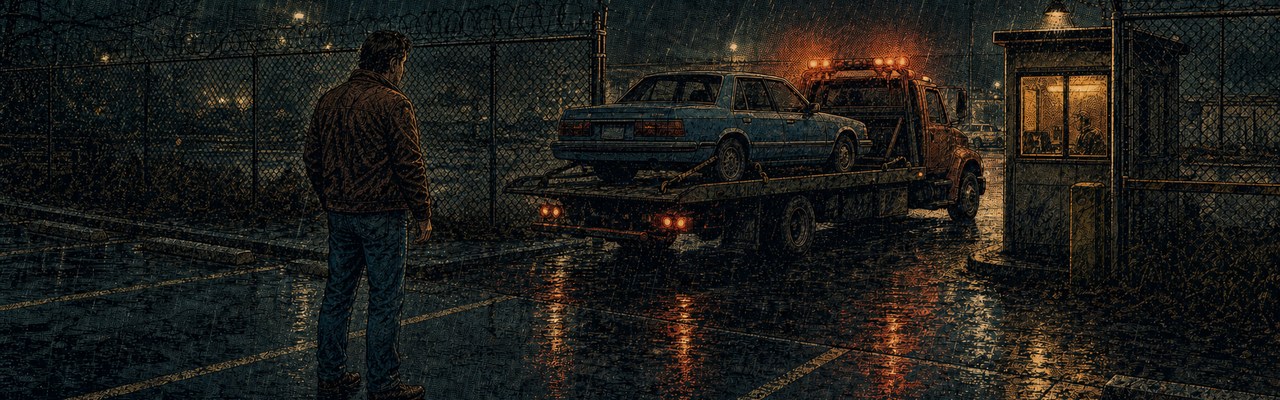
The Situation
You came back to where you parked — the car is gone. This is one of the most stressful situations: your first thought is "it got stolen," but often it's an impound (a tow). According to JD Power, around 76,000 vehicles are towed in the US EVERY DAY. Reasons: parking in a No Parking zone, expired registration, unpaid tickets, DUI arrest, hit-and-run, illegal parking on private property. The problem: impound fees pile up daily ($100-200+ per day of storage), and after 30 days the car can be sold at auction. You need to act fast.
Why It Happens
Main reasons for a tow:
1. Parking in a prohibited zone:
— No Parking signs (red/white signs)
— Fire hydrant (within 15 feet)
— Bus stop, crosswalk, wheelchair ramp
— Blocking a driveway (even your own, on a public street)
— Street cleaning day (posted signs)
2. Expired registration or inspection:
— In some states (CA, NY, TX) police can tow a car with registration expired more than 6 months
— Expired inspection sticker (in states where it's required)
3. Outstanding tickets (unpaid fines):
— Some cities (NYC, Chicago, LA) tow cars with 3+ unpaid parking tickets
— Total amount usually $350+
4. DUI arrest or reckless driving:
— On a DUI arrest the car is towed to an impound lot
— 30-day impound in some states for DUI
5. Hit-and-run:
— If you're caught for a hit-and-run, the car is seized as evidence
6. Abandoned vehicle:
— A car sits in one spot for more than 72 hours without moving (in some cities more than 24 hours)
— Flat tires, visible damage = suspicion it's abandoned
7. Private property towing:
— Apartment complex parking (residents only, and you're a guest)
— Business parking lot (sign "Customers Only, Violators Will Be Towed")
— HOA violations
Step-by-Step Actions
- 1Confirm the car was towed, not stolen:
— Check whether there are No Parking signs around where you parked
— Ask locals, building security — did they see a tow truck
— Look at the pavement — there may be tow-truck tire marks (usually visible) - 2Do NOT call 911 — this isn't an emergency; call the non-emergency police line.
- 3Call the local police non-emergency number:
— Google "[city] police non-emergency"
— Tell them: "My car is missing from [address], I need to find out if it was towed"
— Give: license plate number, make/model/color of the car
— Police will check the database and tell you: 1) Towed (they'll give the impound lot address), 2) No record (possibly stolen — file a stolen vehicle report), 3) You need to wait a couple of hours (records update with a delay) - 4Use an online towed vehicle locator (if available):
— Many cities have websites: NYC 311, LA DOT, Chicago, SF MTA
— Enter license plate or VIN — it shows where the car is and how much the fees are - 5Find the impound lot:
— Police/parking authority will give the impound lot address
— Records can take several hours to update — if it was just towed it may not be in the system; call again in 2-3 hours - 6Gather the required documents BEFORE going to the impound lot:
— Driver's license (valid)
— Proof of ownership: title (pink slip) or registration (if the title is at home, registration is enough in most cases)
— Proof of insurance (current insurance card or a printout from the insurance app)
— Cash — some lots accept cash only, not cards (the ATM may be far away) - 7Arrive at the impound lot:
— Bring ALL documents with you
— If the registered owner is in jail or unavailable, it may be possible to retrieve it with a notarized letter of authorization from the owner (depends on the state) - 8Pay the fees:
— Towing fee: $100-300 (depends on distance)
— Storage fee: $50-200 PER DAY (including the day of the tow + the day of pickup)
— Administrative fee: $50-100
— Outstanding tickets (if the reason for the tow was unpaid fines): you have to pay those too
— Total: expect $300-1,000+ depending on how many days and why it was towed - 9Act FAST:
— Every day = +$50-200 storage fee
— After 30 days (in some states 10-15 days) the impound lot can sell the car at auction to cover the fees
— If the fees exceed the car's value, the lot can declare the car abandoned and sell it sooner - 10If you can't pay the fees right away:
— Ask the supervisor at the impound lot about a payment plan (some lots allow it)
— Ask for a fee waiver for low-income (depends on the city, you need proof of income documents)
— Some cities (LA, SF) have programs for financial hardship - 11If the car was stolen (not towed):
— If police said "no record of a tow," file a stolen vehicle report (online or at the police station)
— Give: license plate, VIN, make/model/color, where you last saw it
— Contact your insurance (comprehensive coverage covers theft)
Real Case: Why This Way and Not Another
How Fees Accumulate
Why are storage fees so high? Impound lots are private businesses that contract with the city. They have limited space (a limited number of cars they can store), plus 24/7 security, liability insurance, administrative staff. Storage fees cover these costs. In cities with high land values (NYC, SF, LA) fees are higher ($150-200/day), in smaller cities lower ($50-100/day).
30-day auction rule. Under the law in most states, if the owner doesn't pick up the car within 30 days (in some states 10-15 days), the impound lot can place a lien on the car and sell it at auction to cover unpaid fees. The lot is required to notify the registered owner by certified mail, but if the owner didn't receive the letter (moved, mail lost), the car is sold anyway.
Phone Numbers
— Non-emergency police: Google "[city] police non-emergency number"
— 311 (in some cities — NYC, Chicago, LA, SF) — general city services, can check towed vehicle records
— Parking authority / DOT of the city — they often have a towed vehicle hotline
How it develops: what's important to understand
What to Say
- Police non-emergency: "My car is missing from [address, cross streets], I need to find out if it was towed. License plate: [number]. Make/model: [Toyota Camry]. Color: [silver]."
- Impound lot: "Hi, my car was towed [date] from [location]. License plate [number]. I'm here to pick it up. What documents do I need and how much are the fees?"
- If you can't pay: "I can't pay $X right away. Is there a payment plan or fee waiver program for financial hardship?"
What NOT to Say/Do
- Don't ignore the situation — every day +$50-200, after 30 days the car will be sold.
- Don't call 911 — this isn't an emergency, use the non-emergency line.
- Don't go to the impound lot without documents — without ID, proof of ownership and insurance they won't release the car, you'll waste your time.
- Don't argue with impound lot staff — they're just enforcing the law, it's not their fault; anger won't lower the fees.
- Don't try to take the car back by force at night — impound lots have security, cameras, fencing; that's burglary/theft = a felony.
Specific situations
Life Hacks
- 1Save your city's non-emergency police number in your phone in advance — when it happens, you won't have to search.
- 2Photograph No Parking signs before parking — if a sign is unclear/hidden, the photo will help contest the tow later.
- 3Always keep registration and insurance card in the car — if it's towed, the documents are in the car and you can't get to them; but the lot requires proof of ownership — keep copies at home or in a phone app.
- 4If the car was towed from private property (apartment, business) — the lot is usually listed on the sign "Violators Towed At Owner's Expense, Call [number]"; call the number, they'll tell you where the car is.
- 5Contest the tow (contest/appeal):
— If you believe the tow was illegal (no signs, broken meter, etc.) — you can file an appeal with the parking authority
— You first have to retrieve the car and pay the fees, then file the appeal
— If the appeal succeeds, the fees are refunded
— Deadline is usually 30 days from the date of the tow
— Success rate is low (~10-20%), but if you have photo evidence (no signs, meter broken) the odds are higher - 6AAA members: some AAA plans include partial reimbursement for tow fees (check membership benefits).
- 7Comprehensive insurance: if the car was towed due to theft or vandalism — comprehensive may cover tow/storage fees (check policy).
- 8Registered owner vs driver: if you're not the registered owner (borrowed car, rental) — only the registered owner can retrieve the car from impound; you need a notarized authorization letter from the owner.
- 9Title vs registration: if the title is at home and you're in another state — registration is enough in most cases; but some lots require the title — call ahead to check.
- 10Low-income fee waiver programs: some cities (LA, SF, Oakland) have programs for people earning below the poverty line; you need proof of income documents (pay stubs, tax return, benefits letter).
- 11If the car is a total loss due to fees: if the fees exceed the car's value (old car, high fees), you can abandon the car — the lot will sell it at auction, keep the fees, and the remaining debt may follow you through collections, but sometimes it's written off.
- 12DUI impound: if the car was towed due to a DUI arrest — in some states (CA) a mandatory 30-day impound; fees can be $2,000-4,000; you can appeal if it's a first offense and there's hardship.
Key facts
- About 76,000 vehicles are towed in the US every day.
- Storage fees run $50-200 per day, including the day of the tow and the day you pick the car up.
- A typical bill for a quick pickup is $300-1,000+; a DUI impound in some states runs $2,000-4,000.
- After 30 days (10-15 in some states) the impound lot may sell an unclaimed car at auction.
- A missing car is NOT a reason to call 911 — call the police non-emergency line or 311 to locate it.
- To retrieve the car you usually need your license, proof of ownership (title or registration), and insurance.
Test yourself
- a) Call 911
- b) Call the police non-emergency line or 311
- c) Wait until morning
- d) Immediately report it stolen
- a) The lot will close for good soon
- b) Every day adds $50-200 in storage fees
- c) Otherwise you'll get another ticket
- d) The car is easier to grab at night
- a) Just cash
- b) License, proof of ownership, and insurance
- c) Registration only
- d) Nothing — it's all in the database
- a) After 3 days
- b) After 30 days (10-15 in some states)
- c) After a year
- d) Never without a court order
- a) 911
- b) The number on the "Violators Towed" sign — the tow company
- c) The DMV
- d) Your insurer
- a) Don't pay and sue right away
- b) Retrieve the car and pay, then file an appeal
- c) Leave the car at the lot until it's resolved
- d) Take the car back by force at night
Answers and explanations
Arrested for DUI
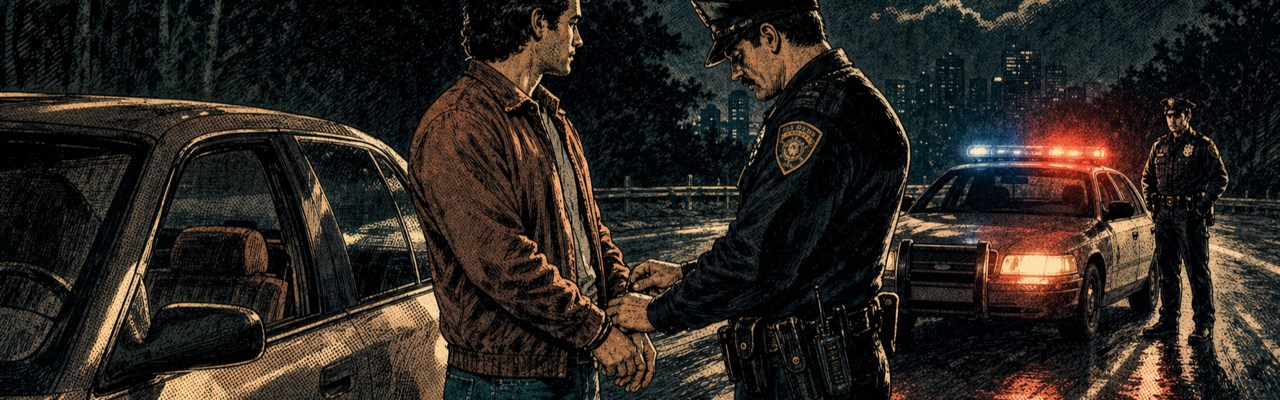
The Situation
DUI (Driving Under the Influence) or DWI (Driving While Intoxicated) is one of the most serious traffic offenses in the US. According to NHTSA, every 50 minutes someone dies in a drunk driving crash. A DUI arrest brings: a criminal record (misdemeanor or felony), license suspension of 3-12+ months, jail time (even for a first offense in some states), fines of $1,000-10,000+, mandatory alcohol education, an ignition interlock device, and an insurance increase of 100-300% for 3-5 years. This is NOT just a ticket — it's a criminal charge with lifelong consequences.
The Penalties (if convicted)
First DUI offense:
— License suspension: 3-12 months (depends on the state)
— Fine: $500-2,000
— Jail: up to 6 months (in most states probation instead of jail for a first offense if BAC isn't too high and no one was hurt)
— Alcohol education program: 12-52 weeks ($500-1,500)
— Ignition interlock device (IID): 6-12 months ($70-150/month for installation + monitoring)
— SR-22 insurance: insurance increase of 100-200% for 3 years
— Probation: 1-3 years
— Community service: 48-96 hours
Total cost of a first DUI: $10,000-15,000 (fees, fines, lawyer, insurance increases, lost wages)
Second DUI:
— License suspension: 1-2 years
— Fine: $1,000-5,000
— Jail: 10 days - 1 year (mandatory minimum in many states)
— Alcohol treatment program mandatory
— IID: 1-3 years
— SR-22: 3-5 years
— Probation: 2-5 years
— Vehicle impound: 30 days
Total cost: $15,000-25,000+
Third DUI (within 10 years):
Felony in most states
— License suspension: 2-10 years or permanent revocation
— Jail: 120 days - 5 years (mandatory minimum)
— Fine: $2,000-10,000+
— Vehicle forfeiture
Total cost: $25,000-50,000+
Aggravating factors that increase the penalty:
— BAC 0.15%+ (twice the legal limit) — enhanced penalties
— Children in the car (<14 years old) — child endangerment charge (a separate felony)
— Accident with injuries — felony DUI, 1-15+ years in prison
— Accident with a death — vehicular manslaughter/homicide, 5-30+ years in prison
— Refusal of the chemical test (breathalyzer/blood test) — automatic license suspension of 1 year+ (implied consent law)
— Reckless driving + DUI — additional charges
— Third+ offense within 10 years — felony
Step-by-Step Actions (IF you're pulled over on suspicion of DUI)
At the scene of the stop:
- 1Be polite and calm — don't argue, don't be rude (the officer's report affects prosecution; aggressive behavior = aggravating factor).
- 2Provide documents when asked:
— Driver's license
— Registration
— Insurance
— Don't say more than necessary: "Here are my documents." — don't tell them where you were or how much you drank. - 3Use your 5th Amendment right to remain silent:
— "Officer, I'm exercising my right to remain silent. I'd like to speak with a lawyer."
— Anything you say can be used against you in court
— "I had one beer 3 hours ago" = an admission that the prosecutor will use - 4Field Sobriety Tests (FSTs) — NOT mandatory in most states:
— Walk-and-turn, one-leg stand, horizontal gaze nystagmus (follow the pen with your eyes)
— You CAN refuse (in most states)
— The officer may arrest you for refusal, but FSTs are subjective (the officer's judgment), and the results are often used against you
— "Officer, I respectfully decline the field sobriety tests." - 5Preliminary Breath Test (PBT/handheld breathalyzer) — NOT mandatory:
— A roadside breathalyzer is NOT the same as the official breathalyzer at the station
— You can refuse (in most states)
— BUT: refusal gives the officer probable cause for an arrest - 6If you're arrested — do NOT resist:
— Cooperate physically (let them put on the handcuffs, get in the police car)
— But STAY SILENT verbally: "I want a lawyer."
After the arrest (at the police station):
- 7Chemical test (breath/blood/urine) — MANDATORY under implied consent law:
— By getting a driver's license you automatically consented to a chemical test upon a DUI arrest
— Refusal = automatic license suspension of 1 year+ (in most states) even if the charges are later dropped
— Refusal is also used as evidence of guilt in court ("he refused because he knew he was drunk")
— Recommendation: take the test (refusal makes things worse); if BAC is below 0.08% — charges may be dropped - 8Request a lawyer immediately:
— "I want to speak with a lawyer before answering any questions."
— Don't answer questions until a lawyer is present
— If you can't afford a lawyer — the court will appoint a public defender - 9Do NOT sign any statements without a lawyer
- 10Bail/release:
— For a first DUI you're usually released within 8-24 hours on your own recognizance (without bail) or on low bail ($500-2,000)
— You'll get a court date (arraignment) in 2-6 weeks - 11Retrieve the car:
— The car is towed to an impound lot
— You need to retrieve it within a few days (storage fees $50-200/day)
— To retrieve it: ID, proof of ownership, insurance, pay the tow/storage fees
After release:
- 12Hire a DUI attorney immediately:
— A DUI lawyer costs $2,500-10,000+ but is critical
— Can negotiate a plea bargain (reduced charges: wet reckless instead of DUI)
— Can find procedural errors (improper stop, breathalyzer calibration issues, Miranda rights violations)
— A public defender is free but usually overworked (150+ cases) - 13DMV hearing (administrative hearing) — SEPARATE from the criminal case:
— After a DUI arrest you have 10 days (in most states) to request a DMV hearing
— If you don't request it — automatic license suspension in 30 days
— The DMV hearing decides the license suspension (administrative penalty)
— The criminal court decides guilt/innocence (criminal penalties)
— Two SEPARATE processes - 14Arraignment (first court appearance):
— They read the charges, you answer Guilty/Not Guilty/No Contest
— Your lawyer recommends pleading Not Guilty at the arraignment (this buys time for negotiation)
— The court sets conditions: alcohol monitoring, no driving, etc. - 15Don't drive without a license:
— After the arrest your license is confiscated, you're given a temporary license for 30 days
— If the DMV suspension takes effect — DO NOT DRIVE
— Driving on a suspended license = a separate misdemeanor: fine $1,000+, jail up to 6 months, extension of the suspension
Real Case: Why This Way and Not Another
The Mechanism: Implied Consent Law
What is Implied Consent? By getting a driver's license, you automatically agree to take a chemical test (breath/blood/urine) if arrested for DUI. It's not an option — it's a condition of having a license. Refusal = a breach of that agreement → an automatic administrative penalty (license suspension) regardless of the criminal case outcome.
Administrative vs Criminal: A DUI involves two separate processes:
1. Administrative (DMV/BMV): concerns your license — suspension/revocation; decided at the DMV hearing
2. Criminal (court): concerns guilt — fines, jail, probation; decided at trial
You can win the criminal case (charges dropped) but lose the DMV hearing (license suspended). Or vice versa.
Phone Numbers
— DUI attorney: Google "[city] DUI lawyer" — the consultation is usually free
— DMV: to request the administrative hearing (deadline 10 days)
— Bail bondsman: if bail is high (usually not needed for a first DUI)
How It Develops: What's Important to Understand
What to Say
- Officer: "Here are my documents. I'm exercising my right to remain silent. I'd like to speak with a lawyer."
- At the station after the arrest: "I want a lawyer. I'm not answering questions without a lawyer present."
- Lawyer: "I was arrested for DUI [date, location]. BAC: [if you know it]. Circumstances: [brief description]. What should I do?"
What NOT to Say/Do
- Don't tell them where you were or how much you drank — these admissions are used against you.
- Don't agree to field sobriety tests (if you want to minimize the evidence against you).
- Do NOT refuse the chemical test at the station — it makes things worse (automatic suspension + used as evidence).
- Don't miss the 10-day DMV hearing deadline — it's the only chance to contest the administrative suspension.
- Don't drive on a suspended license — a separate criminal offense, makes everything worse.
Specific Situations
Life Hacks
- 1Uber/Lyft/taxi > DUI: a $20 ride vs $10,000-15,000 DUI cost. Always.
- 20.08% BAC limit: for most adults that's ~2-3 drinks per hour (depends on weight, sex, metabolism); but 0 drinks is best if you're driving.
- 3Commercial drivers: 0.04% limit. Drivers under 21: 0.00-0.02% (zero tolerance).
- 4"Wet reckless" plea bargain: a lawyer can negotiate a reduced charge of "reckless driving with alcohol" instead of DUI — fewer penalties, doesn't count as a DUI on your record (but some states still count it as priorable for a second DUI).
- 5Ignition interlock device (IID): a breathalyzer installed in the car; you have to blow before every start + random prompts while driving; if you fail = the car won't start.
- 6SR-22 insurance: a certificate of financial responsibility that the state requires after a DUI; the insurance company files the SR-22 with the DMV; it costs more (insurance rates go up 100-200%).
- 7Restricted license: in some states after a suspension you can get a restricted/hardship license (work/school/medical only); requires proof of necessity + IID.
- 8DUI checkpoints are legal: the Supreme Court allowed sobriety checkpoints; an officer can stop anyone without probable cause at a checkpoint; refusing FSTs/PBT = the officer can arrest on an observation basis.
- 9"Reasonable suspicion" for a stop: an officer needs a reason (weaving, speeding, broken taillight); but at a checkpoint no reason is needed.
- 10Marijuana DUI: in states where marijuana is legal, DUI laws still apply; THC impairment = DUI; but there's no per se limit (like 0.08% for alcohol) — the officer relies on FSTs, blood test, drug recognition expert.
- 11Prescription drugs DUI: driving under the influence of prescription medication (even a legal prescription) = DUI if impaired; warning labels "do not operate machinery" = evidence.
- 12Deferred adjudication/diversion programs: some states let first-time offenders complete a program (alcohol education, community service, probation) in exchange for dismissal of charges; but it requires a guilty plea (if you don't complete the program — conviction automatically).
Key Facts
- The blood alcohol concentration (BAC) limit is 0.08% in almost every state; in Utah it's 0.05%.
- For drivers under 21, zero tolerance applies: a limit of 0.00-0.02%.
- For commercial drivers (CDL), the limit is twice as strict — 0.04%.
- The implied consent law applies in all 50 states: refusing a chemical test after arrest means an automatic license suspension.
- In most states you have about 10 days after the arrest to request a DMV hearing to contest the suspension.
- Drunk driving is behind roughly a third (about 30%) of all traffic deaths in the US (NHTSA data).
Test Yourself
- a) Refuse — less evidence that way
- b) Take the test: refusal = automatic license suspension and evidence of guilt
- c) Demand a lawyer be brought in for the test first
- d) Agree only to a urine test
- a) 30 days
- b) About 10 days
- c) One year
- d) There's no deadline
- a) Must do them, or it's jail
- b) May politely decline — they're voluntary and subjective
- c) Must do them only at night
- d) Must first blow into a handheld breathalyzer
- a) "I only had one beer a couple hours ago"
- b) "I'm driving from a bar, but I feel fine"
- c) "Here are my documents. I'm exercising my right to remain silent and I want a lawyer"
- d) Honestly tell them where you were and how much you drank
- a) Drink coffee and wait an hour
- b) Drive slowly on back streets
- c) Call an Uber, Lyft, or taxi
- d) Put a sober passenger next to you as a navigator
- a) A fine process and a tax process
- b) Administrative (DMV — license) and criminal (court — guilt)
- c) Civil and insurance
- d) Only the criminal court
Answers and Explanations
You Drove Into Water / The Road Is Flooded
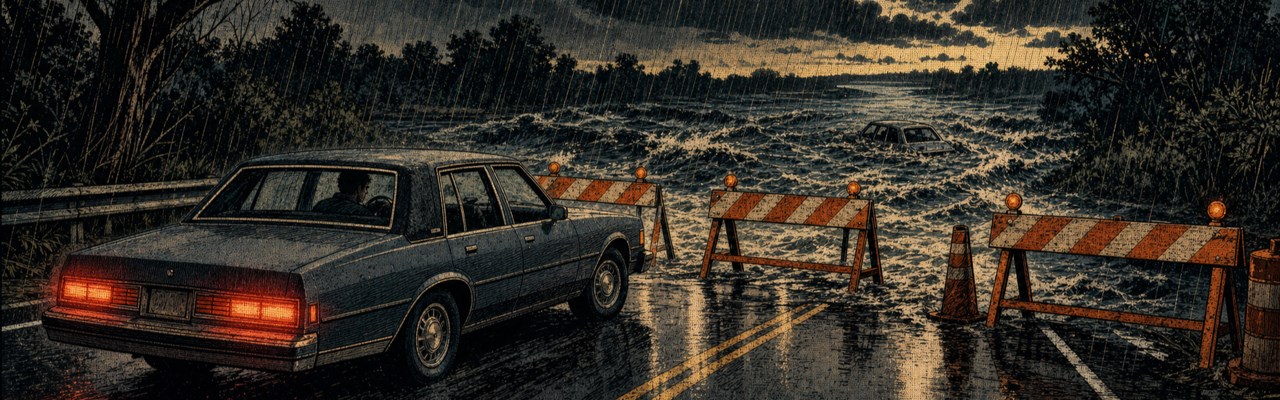
The Situation
More than half of flood-related deaths (50+ a year over the past decade) happen when a driver drives into water. According to the National Weather Service, the problem is so serious that the "Turn Around, Don't Drown" campaign has been running for 20+ years. 12 inches (30 cm) of moving water can sweep away a small car. 2 feet (60 cm) of water will wash away most vehicles, including SUVs and pickups. Modern cars start to float at as little as 12 inches of depth, according to the UK's What Car?.
Why It Matters
Trying to drive through a flooded road leads to catastrophic damage. Just 6 inches of water floods the exhaust system and stalls the engine. Water gets into the air intake — hydrolock occurs (water in the combustion chamber), the engine seizes instantly, repairs cost $3,000-$10,000+ or the car is written off as a total loss. Water destroys the electronics (dashboard, airbags, ABS), corrodes the wiring, and causes long-term failures. Mold grows under the carpets and upholstery (a health hazard + a musty smell you can't get rid of). Insurance only covers it with comprehensive coverage, and many cars are written off as a total loss after flooding.
Step-by-Step Actions
- 1If you see water on the road ahead — stop immediately, don't try to drive through even if it looks shallow; you can't judge the depth visually (the road may have collapsed under the water, hidden objects, washed-out roadbed).
- 2Turn around and look for an alternate route — even if it adds 10-15 minutes, that's nothing compared to the risk to your life and thousands of dollars in damage.
- 3Never drive around barricades — they're put up for a reason; the road under the water may be destroyed or washed out.
- 4If the water is clearly shallow (you can see the bottom, less than 4 inches) AND you're absolutely sure you have to cross — drive at 3-4 mph (walking pace), aim for the center of the road (water drains to the edges, the center is often shallower), and wait for oncoming traffic to pass (their wave will flood your engine).
- 5Ordinary passenger cars — a maximum of 100mm (4 inches) of safe depth; high-clearance 4x4/SUV — up to 10-12 inches ONLY at a slow speed.
- 6If the engine stalls in the water — evacuate immediately, get out of the car and head to higher ground; the water can rise fast.
- 7Do NOT try to restart the engine after it stalls in water — this is guaranteed to destroy the engine (hydrolock followed by bent connecting rods).
- 8If water is rising fast around the car — unbuckle your seatbelt and take off a heavy jacket immediately so it doesn't get in the way during evacuation.
- 9Lower the windows slowly (power windows may stop working once water fills the cabin); if a door won't open — wait until the cabin is almost completely full of water (the pressure equalizes), then the door will open.
- 10Keep an emergency tool in the car (window breaker + seatbelt cutter) — NPR's recommendation in case the water rises fast and the windows fail.
- 11Call 911 and report your location if the car is swept away by water, stuck, or you're trapped.
Real Case
How the Situation Develops
Consumer Reports and insurance companies document that cars after a flood often have hidden damage that shows up months later. The electronics malfunction, corrosion spreads in hidden places, and mold can't be fully removed even with professional cleaning. Many states require branding the title as "flood damage" for such cars, which lowers the resale value by 50%+. Kelley Blue Book recommends: if the car was in a flood (water above the sills), sell it "as is" or accept it as a total loss from the insurer — trying to keep it is not economically worthwhile.
What to Say
- To the 911 dispatcher — your exact location: road name, nearest intersection or mile marker, direction. Say the car is in water and the level is rising.
- How many people are in the car and whether there are children, elderly, or injured — this determines the rescue crew's priority.
- Stay on the line and report if the water is rising or the car is being swept — the dispatcher relays this to rescuers in real time.
What NOT to Say
- Don't tell yourself "it's surely shallow, I'll make it" — you can't judge the depth or the force of the current by eye, especially at night.
- Don't tell the dispatcher "it's fine, I'll get out myself" if the water is rising — underestimating the situation delays rescuers.
- Don't tell passengers "stay put, we'll wait it out in the car" when water is rising fast — the cabin can fill in seconds; the decision to evacuate is made right away.
Specific Situations
Life Hacks
- 1Check the weather forecast before a trip — the National Weather Service issues a Flood Watch (flooding possible), Flood Warning (flooding is happening or imminent), Flash Flood Warning (a sudden flood right now — get to higher ground IMMEDIATELY).
- 2Avoid flood-prone areas (low-lying spots, underpasses, dips in the road) during a downpour — they flood first.
- 3If you're driving after or during heavy rain — slow down 10-15 mph below the limit and increase your following distance so you can see hazards sooner.
- 4Know detour routes for frequently flooded spots — locals always know where "that one underpass" floods cars every season.
- 5Never rely on the idea that "it used to be shallow here" — the water level changes in minutes, the current washes out the roadbed, and there may be holes under the water.
- 6Subscribe to local emergency alerts through a mobile app — many cities send push notifications about road closures due to flooding in real time.
- 7If you regularly drive in flood-risk areas — download offline maps in Google Maps or MAPS.ME in advance so you can see alternate routes even without internet.
- 8Keep the fuel tank at least half full during the rainy season — if you have to detour through other areas, you'll have a reserve of fuel.
- 9Some states (Texas, Arizona) have a "Stupid Motorist Law" — if you ignore barricades and get stuck, they'll bill you for the rescue operation (hundreds or thousands of dollars).
- 10After driving through shallow water (if you had to) — test the brakes at a safe speed: press lightly a few times to dry the brake rotors of water, otherwise the brakes may fail at a critical moment.
Key Facts
- More than half of flood deaths involve vehicles — a driver drives into the water.
- 6 inches (15 cm) of water floods the exhaust and stalls a passenger car's engine.
- 12 inches (30 cm) of moving water can sweep away a small car; 2 feet (60 cm) — most vehicles, including SUVs and pickups.
- Hydrolock after driving into water — engine repair of $3,000–$10,000+ or a write-off as a total loss.
- The National Weather Service "Turn Around, Don't Drown" campaign has run for over 20 years.
- In Texas and Arizona, the "Stupid Motorist Law" lets authorities bill a driver for the rescue if they drove around barricades.
Test Yourself
- a) Drive through fast so you don't stall
- b) Turn around and find a detour
- c) Check the depth by dipping a wheel in
- d) Follow another car through
- a) 3 inches
- b) 6 inches
- c) 12 inches (30 cm)
- d) 4 feet
- a) Restart the engine right away
- b) Don't restart, and head to higher ground
- c) Wait for help in the car
- d) Rev the engine to drive out
- a) Kick the door as hard as you can
- b) Wait until the cabin is almost full of water, then open the door
- c) Try to start the car
- d) Stay buckled in and wait
- a) Drive around it on the shoulder
- b) Never go around — turn back
- c) Move the barricade and drive through
- d) Drive slowly through the water
- a) Put it in the garage to charge right away
- b) Don't park it near buildings; move it to an open area and get an inspection
- c) Keep driving if it starts
- d) Just dry out the cabin
Answers and Explanations
You Locked the Keys in the Car
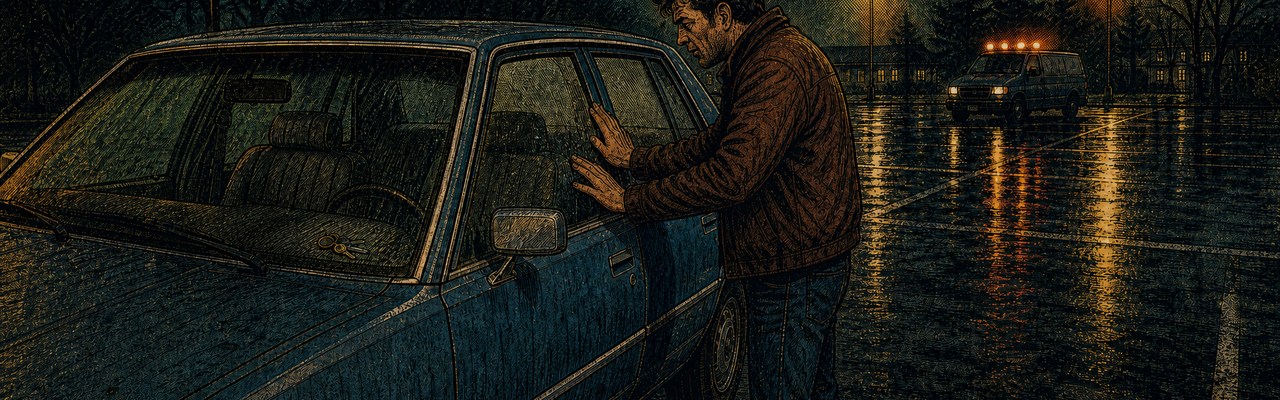
The Situation
10% of all AAA calls in 2024 were related to lockouts — that's about 4 million cases across the country. Since 2007 the share of lockouts has dropped from 13% to 10% thanks to the spread of keyless entry in new cars, but the problem is still common. Keys locked in the car aren't just an inconvenience: if a child or pet is left inside, especially in heat or cold, every minute counts.
Step-by-Step Actions
- 1Stay calm — panic won't help, and technology and services will handle this quickly.
- 2Check all the doors and the trunk — AAA drivers often arrive and find that another door is unlocked or a window is cracked open.
- 3Check the car's mobile app — if you have a Nissan, Toyota, Ford, Honda, GM/Chevy, Subaru, or Hyundai (recent-year models), your phone can work as a key and unlock the doors remotely.
- 4If there's a child or pet inside in danger (heat, cold, signs of distress) — call 911 immediately; this is an emergency where every minute is critical to life.
- 5If there's no threat to life — call AAA at 1-800-222-4357; a technician will come and open the car on the spot, this is included in all membership tiers.
- 6If AAA can't open it (rare) — they'll tow it to the dealer or a locksmith, or reimburse the locksmith cost ($50 for Classic members, $100 for Plus/Premier).
- 7Check the roadside assistance in your auto insurance — many policies include lockout help at no extra charge.
- 8If you don't have AAA or insurance — call a certified locksmith (license, insurance, positive reviews are a must); the cost is usually $50-$150 depending on the complexity of the lock.
- 9If a friend or relative has a spare key — ask them to bring it over; this can be faster than any service.
- 10Check for an alternate entry — with hatchbacks and SUVs you can sometimes get in through the trunk and fold down the rear seats to climb inside.
Real Case: When the Police Actually Step In
The Mechanism: Why Modern Cars Suffer Lockouts Less Often
Cars made after 2017 are increasingly equipped with lockout-prevention systems. When the sensors detect a key inside the cabin or in the ignition, the system locks the central locking and won't let you lock the doors. That's exactly why AAA statistics show lockouts dropping from 13% in 2007 to 10% in 2024. However, older cars and some budget models don't have such systems.
How It Develops: What's Important to Understand
What to Say
- To the 911 dispatcher (if a child or pet is inside): say it right away and clearly — "there's a child locked in the car, in the heat, in distress" — and give the exact address. This bumps the call to top priority.
- To a locksmith or AAA: give your membership number, the exact location, and the make, model and year of the car, and that you locked the keys inside — it speeds up sending the right person and tools.
- To a locksmith, before any work starts: "Tell me the full price and confirm your license and insurance." An honest one answers on the spot.
What NOT to Say
- Don't downplay it to 911: if a child or pet is inside, don't say "it's nothing urgent" — that delays help when every minute counts.
- Don't tell a locksmith "do whatever, I'll pay whatever it costs" — without a price agreed in advance, a dishonest one will hand you an inflated bill.
- Don't get upset or refuse when a locksmith asks you to prove the car is yours (license, registration) — it's standard anti-theft protection, not them being difficult.
Specific Situations
Phone Numbers
— AAA: 1-800-222-4357 (1-800-AAA-HELP) — for members, lockout is included in the membership
— 911 — ONLY if there's a child/pet inside in danger (heat, cold, signs of distress)
— Auto insurance roadside assistance — check the number in your policy, many insurers include lockout
Life Hacks
- 1Keep a spare key in your wallet or bag (separate from your main keyring) — it's the simplest insurance against a lockout.
- 2Leave a spare key with a trusted neighbor or relative, not in a magnetic box on the car (thieves know all the popular spots and the boxes often fall off or rust).
- 3Use the key to lock the door (rather than the button from inside) when you lock the car — this forces you to keep the keys in your hand and not leave them inside.
- 4A bright key fob (neon, reflective) helps you see the keys and not leave them in the cabin.
- 5Before getting out of the car, always check that you have the keys — a visual check (keys in hand?) reduces lockouts by 90%.
- 6Keyless entry systems (on most cars since 2017) prevent lockouts automatically, but still keep a spare key at home in case the fob battery dies.
- 7A code-protected lockbox at home for the spare key (not on the car) is a safe alternative to a magnetic box if you need to keep a key accessible.
- 8If your car supports a mobile app (Ford, GM, Toyota, etc.) — set it up in advance and keep your phone charged; it can become your backup key.
- 9Check whether roadside assistance is included in your auto insurance — many drivers pay for it without knowing, and lockout is part of the coverage.
- 10If you get locked out often (2+ times a year) — invest in an AAA membership ($50-$120/year); it pays for itself with the first call, plus it gives you towing, battery replacement, fuel delivery, and other benefits.
Key Facts
- About 4 million AAA calls a year are lockouts — 10% of all calls in 2024.
- Since 2007 the share of these calls has dropped from 13% to 10% thanks to keyless entry in new cars.
- A locksmith call usually costs $50–$150 depending on the complexity of the lock.
- AAA reimburses a locksmith up to $50 for Classic members and $100 for Plus/Premier.
- Replacing a broken car window runs $200–$400 — which is why you only break one when a life is at risk.
- A simple visual "keys in hand?" check before getting out cuts the risk of a lockout by about 90%.
Test Yourself
- a) Break the nearest window
- b) Stay calm and check all the doors and the trunk
- c) Slide a coat hanger into the door
- d) Leave and come back tomorrow
- a) AAA
- b) A locksmith
- c) 911
- d) The dealer
- a) 911
- b) 1-800-222-4357
- c) 411
- d) 1-800-555-0100
- a) Yes, it's their direct duty
- b) No, it's a non-emergency; at best they'll call a tow you pay for
- c) Yes, and they'll open it for free
- d) Yes, but they'll write you a ticket
- a) Yes, it's quick and free
- b) No — you can damage the electronics and airbags, and repairs cost hundreds
- c) Yes, if the car is older than 2017
- d) Only if there's a video tutorial
- a) Never lock the car
- b) Keep a spare key (in your wallet or with a neighbor)
- c) Leave a window cracked open
- d) Hide a key in a magnetic box under the bumper
Answers and Explanations
Got into an accident with an uninsured driver
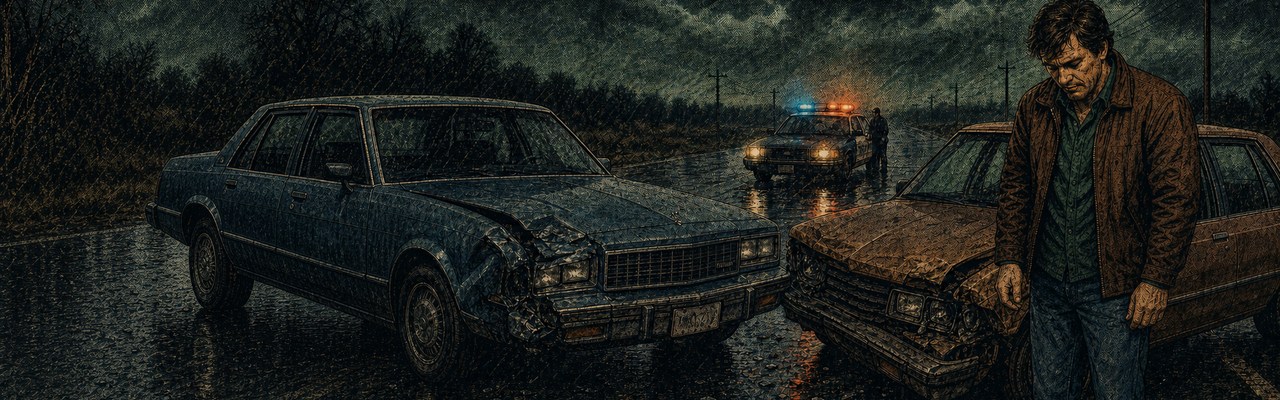
The situation
An accident with an uninsured or underinsured driver is a common problem in the US. According to the Insurance Research Council, about 13% of drivers in the US (1 in 8) drive without insurance, and in some states (Florida, New Mexico, Michigan) that figure reaches 20-26%. Even if the other driver is at fault, their lack of insurance means there's no one to file a claim against to cover your damages. Your options: 1) Uninsured/Underinsured Motorist coverage (UM/UIM) on your policy (if you have it), 2) Sue the at-fault driver personally (but if they have no money, a judgment is useless), 3) Collision coverage (covers your car regardless of fault), 4) Pay out of pocket.
What you face (if the at-fault driver has no insurance)
For the at-fault driver (uninsured driver at fault):
— Driving without insurance = breaking the law in most states: a $500-5,000+ fine, license suspension for 3-12 months, vehicle impound, SR-22 requirement after reinstatement
— If at fault in an accident + uninsured: personal liability for all damages (your car, your medical bills, lost wages) — can be sued, wage garnishment, property liens
— In some states (NY, NJ, NC) — criminal charges for driving without insurance
For you (the victim):
— If you have no UM/UIM coverage and no collision: you may be left without compensation (the uninsured driver is judgment-proof if they have no assets)
— Even if you win the lawsuit, collection can take years or be impossible
Step-by-step actions
At the accident scene:
- 1Act as you would for any accident:
— Check for injuries (call 911 if any)
— Move the cars if safe (minor accident, no injuries)
— Turn on hazard lights
— Do NOT leave the accident scene - 2Call the police even for a minor accident — especially important if you suspect the other driver has no insurance; the police report will be critical evidence.
- 3Exchange information:
— The other driver's name, phone, address
— Driver's license number
— License plate, make/model/color of the car
Insurance information: ask for the insurance card
— If the other driver says "I have no insurance" or can't show an insurance card — that's a red flag - 4Document everything:
— Photos of both cars (all damage, license plates, VIN if visible)
— Photos of the accident scene (position of cars, traffic signs, road conditions)
— Photos of the other driver's driver's license (if allowed)
— If there are witnesses, write down their contacts - 5Police report:
— The officer will fill out an accident report
— The report will note: fault determination (preliminary), whether the drivers have insurance
— Get a copy, the report number, or where to obtain the report later
After the accident:
- 6Check whether the other driver has valid insurance:
— Write down the insurance company name and policy number from their insurance card (if they showed it)
— Call their insurance company: "I was in an accident with your insured [name], policy number [number], please confirm coverage on [accident date]"
— The insurer will say: coverage active or no coverage (policy lapsed, canceled, invalid) - 7If it's confirmed the at-fault driver has no insurance or coverage is insufficient:
Option A: Use your own Uninsured/Underinsured Motorist coverage (UM/UIM):
— Call your own insurer: "I was in an accident with an uninsured driver, I want to file a claim under my UM coverage"
— UM coverage covers: your medical expenses, lost wages, pain and suffering, your car (if UMPD — Uninsured Motorist Property Damage — is included)
— Your insurer will pay you up to your policy limits (usually $25k-100k)
— Deductible: depends on state and policy (sometimes no deductible for UM, sometimes $250-500)
— After paying out, your insurer may pursue the uninsured driver for reimbursement (subrogation), but that's their problem
Option B: Use your own Collision coverage:
— Collision covers damage to your car regardless of fault
— File a claim: "I was in an accident, the other driver is at fault but uninsured, I want to use collision coverage"
— The insurer will pay for repairs minus your deductible (usually $500-1,000)
— Your premium may go up even if you're not at fault (unfair but that's how it works at some companies)
— The insurer may pursue the other driver for reimbursement + your deductible
Option C: Sue the uninsured driver personally:
— Hire a personal injury lawyer or file in small claims court (if the damage is <$5,000-10,000, depends on the state)
— Win a judgment: the court rules that the at-fault party must pay you $X
BUT: collecting the judgment = a separate problem:
— If the at-fault party has no assets, no job, no income — the judgment is useless (judgment-proof)
— You can try wage garnishment (if they have a salary), property liens, bank account levy
— The process can take years
— Cost-benefit analysis: lawyer fees ($2,000-5,000+) vs the amount of damage
Option D: Pay out of pocket:
— If the damage is small ($500-1,000), you have no UM/collision, and a lawsuit isn't worth the effort — you can just pay yourself
— It's a worst-case scenario but sometimes the only realistic option - 8If you have NO UM coverage and NO collision:
— The only option is to sue the at-fault driver personally
— Your chances of full recovery are low if the at-fault party has no money
— It's a lesson for the future: ALWAYS carry UM/UIM coverage (costs $50-150/year extra but is critical) - 9File a claim with the DMV (if required by your state):
— Some states require reporting the accident to the DMV if damage is >$1,000-2,500 or there are injuries
— The deadline is usually 10 days - 10Monitor your car's repair:
— If you used collision coverage: the insurer sends an adjuster, assesses the damage, issues an estimate, pays for repairs (minus the deductible)
— You can choose the body shop (some insurers have preferred shops but you're not obligated) - 11If the at-fault driver fled the scene (hit-and-run):
— This is even worse: no information about the at-fault driver
— File a police report immediately
— Uninsured Motorist coverage usually covers hit-and-run too (the at-fault driver = unidentified uninsured driver)
— If you have dashcam video or witnesses — critical
If YOU are uninsured and got into an accident (not at fault):
- 12Even if you're not at fault, driving without insurance = a violation:
— A $500-5,000+ fine
— License suspension
— If the other driver is at fault and has insurance — their insurer should cover your damages (their insured is at fault), BUT:
— Some states (NC, NJ) bar uninsured drivers from recovering damages even when not at fault
— They may only grant compensation for property damage, not medical/pain and suffering
— You can also be cited for driving without insurance regardless of fault
A real case: why this way and not another
How it works: Uninsured Motorist coverage
What is UM/UIM coverage? It's an optional coverage on your auto insurance policy (in some states required by law). It covers you if:
— The at-fault other driver has no insurance (uninsured)
— The at-fault other driver has insufficient insurance (underinsured): for example their liability limit is $15k but your damage is $30k
— Hit-and-run (the at-fault driver isn't found = uninsured)
UM/UIM limits: you usually choose them when buying the policy: $25k/50k, $50k/100k, $100k/300k (first number = per person, second = per accident). Cost: $50-200/year extra depending on limits.
UM vs UIM: Uninsured = 0% coverage from the at-fault party. Underinsured = there's coverage but insufficient. For example the at-fault party has $15k liability, your damage is $40k — their insurer pays $15k, your UIM pays the remaining $25k (up to your UIM limit).
Phone numbers
— Your insurance company: file a UM/collision claim
— The at-fault driver's insurer: check coverage status
— Personal injury lawyer: if you're considering a lawsuit (many work on contingency — 33% of the settlement, no upfront fee)
— DMV: if reporting the accident is required
How it develops: what's important to understand
What to say
- To the other driver at the scene: "Are you OK? Let's exchange information. Can I see your insurance card?"
- To the at-fault driver's insurer (by phone): "Hello, I was in an accident with your insured [name], policy [number], it happened on [date]. Please confirm coverage was active on that date."
- To your own insurer: "I was in an accident with an uninsured/underinsured driver. The other driver is at fault (there's a police report). I want to file a claim under my UM/UIM coverage. Policy number [number], claim for [medical/property damage]."
- To a lawyer (if a lawsuit): "I was in an accident, the other driver is at fault but uninsured. My damage is $X. I have no UM/collision coverage. Can you help me sue the at-fault driver? Do you work on contingency?"
What NOT to say/do
- Don't agree to "settle cash" on the spot with an uninsured driver — "I'll give you $500 in cash, don't call the police" — this is almost always a bad idea (injuries may show up later, damage is greater than it looks, no paper trail).
- Don't leave the accident scene even if the other driver fled — you still need to wait for the police, otherwise it's a hit-and-run on your part.
- Don't delay the claim — many policies require filing within 24-72 hours.
- Don't admit fault — even if it seems like you're to blame, let the insurers/police sort it out; you may be partially at fault, not 100%.
Specific situations
Life hacks
- 1ALWAYS buy UM/UIM coverage — it's one of the most important coverages; the uninsured rate in the US is 13% = 1 in 8 drivers; the chance of an accident with an uninsured driver is high.
- 2High UM limits — it's recommended to match your liability limits: if you have $100k/$300k liability, get $100k/$300k UM/UIM.
- 3UMPD (Uninsured Motorist Property Damage) — in some states this is separate from UM (which only covers medical); UMPD covers damage to your car from an uninsured driver; if you have no collision — UMPD is essential.
- 4Collision coverage is useful too — even if the car is old; collision covers your car regardless of who's at fault, which gives peace of mind.
- 5A dashcam is critical — if it's a hit-and-run or the other driver lies about fault, video = undeniable evidence; $50-150 one-time cost.
- 6Check the insurance card at the scene — if the other driver shows an insurance card, photograph it; then verify coverage by calling the company.
- 7"Insurance follows the car, not the driver" (usually) — if you were hit by a driver who borrowed someone's car, the car owner's insurance usually covers it (not the driver's insurance). Find out who owns the car (registration).
- 8Uninsured Motorist Fee in some states — if you reject UM coverage, you pay an annual fee (~$25-50) into a DMV fund that compensates victims.
- 9Small claims court for small amounts (<$5k-10k) — no lawyer needed, you can file yourself, court fee $30-75, trial in 1-3 months; but collecting the judgment is still your responsibility.
- 10Wage garnishment process: if you win a judgment, you can file a court order to garnish the at-fault party's wages (usually 10-25% of each paycheck until the debt is paid); but you need to know where they work.
- 11Judgment liens on property: if the at-fault party owns a house, you can put a lien — when they sell, you get money from the sale proceeds; but if they don't sell, the lien can sit for years.
- 12Statute of limitations for a lawsuit: usually 2-4 years from the accident date (depends on the state); don't miss the deadline.
- 13Medpay coverage (Medical Payments) — another optional coverage: covers your medical bills regardless of fault, no deductible, fast payment; a supplement to UM.
- 14If the at-fault party is a foreign tourist without US insurance — it's like an uninsured driver; UM coverage is your only option (a lawsuit against someone in another country = impossible).
- 15Reject cash settlements on the spot — if the uninsured driver offers cash "let's skip the insurance/police" — most likely it won't be enough money (repairs cost more than they look) + injuries may show up days later; insist on the official process.
Key facts
- About 13% of drivers in the US (1 in 8) drive without insurance; in some states it's 20–26%.
- UM/UIM coverage costs roughly $50–200 a year on top of the base policy.
- Typical UM/UIM limits: $25k/50k, $50k/100k, $100k/300k (per person / per accident).
- Most policies require you to file a claim within 24–72 hours of the accident.
- The statute of limitations for an accident lawsuit is usually 2–4 years depending on the state.
- A hit-and-run is usually covered by UM coverage as a case with an uninsured at-fault driver.
Test yourself
- a) Your UM/UIM coverage, if you had it before the crash
- b) Their apology at the scene
- c) The at-fault party's promise to pay later
- d) Nothing, since they're uninsured
- a) On the day of the accident
- b) Right after the crash
- c) When you get the police report
- d) In advance, before the accident
- a) The money comes automatically
- b) The police will collect it for you
- c) There's almost nothing to collect, the process can drag on for years
- d) The state pays the sum instead of them
- a) Nothing can be done
- b) UM coverage usually covers hit-and-run too
- c) Only pay yourself
- d) Sue an unknown person
- a) Their insurer will pay it all
- b) The DMV will cover the rest
- c) Your UIM — up to your limit
- d) No one, the difference is your loss
- a) Agree and drive off
- b) Decline and call the police: injuries and damage surface later
- c) Take the money and stay quiet
- d) Haggle up to $1000
Answers and explanations
Child or pet in a hot car
The situation
Hot car deaths are tragedies that can be prevented. According to Kids and Cars Safety, on average 39 children die every year in the US from heatstroke in locked cars. The temperature inside a car can rise by 20°F (11°C) in 10 minutes, by 40°F in 30 minutes — even if it's only 70°F (21°C) outside, it can be 110°F+ (43°C+) inside. Children overheat 3-5 times faster than adults (smaller bodies, worse thermoregulation). Pets are at risk too: dogs don't sweat (only through their paws and mouth) and get heatstroke quickly.
Scenarios:
1. You left a child/pet in the car (even "just for a minute") — this can be illegal, and the child can die
2. You see someone else's child/pet in a locked car in the heat — you need to act fast to save them
What you face (if you left a child/pet in a hot car)
Child:
— Child endangerment (threat to a child's life): a misdemeanor or felony depending on the state and the circumstances (how long, what temperature, the child's age, whether harm occurred)
— If the child died: manslaughter or negligent homicide — 2-20+ years in prison
— Even if the child survived without harm: a $500-10,000 fine, jail time up to 1 year, a CPS investigation, possible loss of custody
— A civil lawsuit from the other parent or family members
Pet:
— Animal cruelty / animal neglect: a misdemeanor (most states), in some states a felony
— A $500-5,000 fine, jail up to 1 year, a ban on owning animals
— If the pet died: more serious charges + possibly a felony in some states
Step-by-step actions
If YOU accidentally left a child/pet in the car:
- 1Go back immediately and get them out:
— Every minute is critical
— If you forgot about the child in the backseat — this is "forgotten baby syndrome" (it can happen to anyone: stress, a change of routine, sleep deprivation) - 2Assess the child's/pet's condition:
— Signs of heatstroke in a child: red, hot skin, rapid pulse, disorientation, lethargy, unconsciousness, vomiting
— Signs of heatstroke in a dog: excessive panting, drooling, red tongue/gums, vomiting, diarrhea, collapse, seizures
— If THESE signs are present — 911 immediately - 3Cool them down:
— Move them out of the heat into the shade or an AC space
— Pour cool (NOT icy) water over them
— Wet towels on the neck, armpits, groin
— Give them cool water to drink (if conscious)
— Do NOT submerge in icy water (thermal shock) - 4Call 911 if there are serious symptoms
- 5Be ready for legal consequences:
— Police investigation
— CPS involvement (for a child)
— Animal control (for a pet)
— Possible arrest/charges
If YOU see someone else's child/pet in a locked car in the heat:
- 6Assess the situation:
— Is the child in distress? (crying, red, limp, unresponsive)
— Is the pet in distress? (excessive panting, drooling, lying motionless)
— How hot is it? (direct sunlight, all windows closed)
— How long (ask bystanders) - 7Try to find the owner:
— If it's a store parking lot — ask them to make an announcement over the PA system: "Owner of the [make/color] car, license [number], return to your car immediately, there's a child/dog inside"
— Ask bystanders — did anyone see someone get out of the car - 8Call 911 immediately:
— "Child/dog trapped in a locked car, parking lot [location], temperature [X°F], the child appears to be in distress"
— The dispatcher will send police/fire/EMS
— Stay on the line - 9Decide whether to break a window:
Good Samaritan laws: most states have laws that protect you from criminal/civil liability if you break a window to save a child or animal in a hot car, BUT the requirements vary:
— Reasonable belief that the child/animal is in imminent danger
— You called 911 first
— You tried to find the owner (if there was time)
— You used no more force than necessary (break one window, not all of them)
— You stayed at the scene until the police arrived
When to break a window:
— The child is unconscious, unresponsive, clearly in distress
— The pet has collapsed, isn't moving, tongue blue/pale
— Police/fire told you by phone "break window if needed"
— Too hot + too long + owner not found within 5-10 minutes
How to break a window:
— Choose the window furthest from the child/animal (usually the rear side or front passenger side)
— Use something heavy (a rock, a hammer, a metal object)
— Strike a CORNER of the window (easier to break than the center)
— After breaking it: open the door, get the child/animal out
— First aid: cool them down, wet towels, water - 10Stay at the scene until the police arrive:
— Explain the situation
— Give a statement
— The police will document: the temperature inside the car (they have thermometers), the condition of the child/animal, your actions - 11Don't be afraid of legal consequences (if you acted in good faith):
— Good Samaritan laws protect you
— The owner may be angry/threaten a lawsuit, but courts are usually on the rescuer's side if there was real danger
If you're the owner and you came back to the car to find a broken window / police on scene:
- 12Cooperate with the authorities:
— Explain why you left the child/pet
— "I was in the store for 5 minutes" (the police will check via cameras — if it was longer, it'll be worse)
— Don't lie, don't be aggressive - 13Accept the consequences:
— The child will be examined by medics
— A CPS investigation (if a child)
— The police may arrest/cite you
— You will be responsible for the window + possibly damages to the rescuer (unlikely if a Good Samaritan law applies)
A real case: why this way and not another
How overheating works
Why so fast? A car = a greenhouse (greenhouse effect): sunlight passes through the windows, heats the interior, heat trapped inside (it can't escape). Even "windows slightly cracked" doesn't help — you need cross-ventilation (two open windows opposite each other), but even that isn't enough in the heat.
Temperature rise: studies show:
— After 10 minutes: +19°F (+10°C)
— After 20 minutes: +29°F (+16°C)
— After 30 minutes: +34°F (+19°C)
— After 60 minutes: +40-45°F (+22-25°C)
If it's 80°F (27°C) outside, inside after 30 minutes = 114°F (46°C). Heatstroke starts at a body temperature of 104°F+ (40°C). Death at 107°F+ (42°C).
Children vs adults: children overheat 3-5 times faster because: smaller bodies (less thermal mass), higher metabolic rate, worse thermoregulation (they sweat less), can't self-rescue (can't open the door).
How it develops: what's important to understand
Phone numbers
— 911 — if a child/pet is in a hot car in distress
What to say
- 911 (if you see a child/pet): "Child/dog trapped in a locked car, [location, parking lot name], the child appears [unconscious/crying/lethargic], outside temperature [X°F], all windows closed, can't find the owner."
- To the store (PA announcement): "Urgent announcement: owner of the [make/color] car, license plate [number], return to your car immediately."
- Police (when they arrive): "I saw a child in distress in the car, called 911, tried to find the owner, the dispatcher told me to break the window if needed, the child was [description of condition], I broke the window and got them out."
What NOT to say/do
- Don't leave a child "just for a minute" — even if it seems like it'll be quick, IT'S NOT WORTH THE RISK; take the child with you or ask someone to sit with them.
- Don't leave a pet in the car in summer — even 5 minutes can be deadly; leave them at home or have one person stay with the pet with the AC on.
- Don't rely on "windows cracked" — it barely helps.
- Don't think "it won't happen to me" — forgotten baby syndrome can happen to anyone (stress, change of routine, sleep deprivation).
- Don't hesitate to break a window if a life is in danger — a Good Samaritan law protects you; better a living child and a broken window than a dead child and an intact car.
Specific situations
Life hacks
- 1"Look Before You Lock" rule: before getting out of the car — always check the backseat, even if you're not carrying a child (make it a habit).
- 2Put something important in the backseat (phone, bag, wallet) — it will force you to open the back door before leaving.
- 3Reminder systems:
— Put a stuffed animal on the driver seat when the child is in the car seat — the toy will remind you
— Set an alarm on your phone "check backseat"
— Some new cars have a rear door alert - 4Call/text routine: arrange with the daycare/spouse that you always call when you've dropped off the child; if you didn't call — they call you to check.
- 5If you see a car with a child — act fast: don't assume "the owner will be right back" — every minute is critical.
- 6Good Samaritan laws by state: most states have them (AZ, CA, CO, FL, IN, LA, MA, OH, TN, VT, WI and others); check your state's law.
- 7You can gauge the temperature inside the car: open the door for 2 seconds — if you're instantly uncomfortable (hot air hits your face) — it's worse for the child/animal.
- 8A thermometer in the car: if you have a digital thermometer, you can show the police "the temperature inside was 125°F when I found them."
- 9Never leave keys/a remote with a child in the car — the child can accidentally lock the doors from inside and won't be able to open them.
- 10If you forgot the child (forgotten baby syndrome): it can happen if: the routine changed (usually your partner drops them off, today it's you), sleep deprivation, stress; acknowledge that it's a real risk and use reminders.
- 11For pets: if you need to travel with a dog in the heat — plan stops where you can take the dog with you (pet-friendly stores, outdoor cafes) or leave them at home.
- 12Portable AC fan: if you absolutely must leave the pet for a short time (for example an emergency), a portable battery-powered fan is better than nothing (but still risky).
- 13Heatstroke first aid for a child:
— Move to shade/AC
— Remove clothing
— Cool wet towels on the neck, armpits, groin (where the large blood vessels are)
— Fan air
— Sips of water if conscious
— 911 immediately - 14Heatstroke first aid for a dog:
— Move to shade/AC
— Cool (not icy) water on the body
— Wet towels on the head, neck, belly
— Give cool water to drink
— Emergency vet immediately - 15A sign of heatstroke vs just hot: if core body temperature is >104°F = heatstroke (rectal thermometer); but if there's no thermometer — go by symptoms (confusion, seizures, unconsciousness = emergency).
Key facts
- On average about 37-39 children die each year in the US from vehicular heatstroke.
- A car's interior can rise about 20°F in 10 minutes and 40°F+ within an hour, even on a mild day.
- More than half of hot-car child deaths are children unknowingly left behind; about a quarter climbed in on their own.
- Heatstroke begins at a core body temperature of 104°F and becomes lethal around 107°F.
- Cracking the windows does not meaningfully slow the temperature rise.
- Children's bodies heat up 3-5 times faster than adults'.
- Most states have a Good Samaritan law that can shield someone who breaks in to rescue a child, and a growing number cover pets too.
Test yourself
- a) About 2°F
- b) About 20°F
- c) It stays the same if the windows are cracked
- d) Only in direct sun, otherwise nothing
- a) Break the window right away
- b) Call 911
- c) Wait 20 minutes for the owner
- d) Post about it online
- a) Yes, that solves it
- b) No, it barely slows the heat
- c) Yes, if it's under 90°F outside
- d) Yes, for pets but not children
- a) Nothing special, you're always covered
- b) Have a reasonable belief of imminent danger, call 911 first, use minimal force, and stay at the scene
- c) Be a police officer or firefighter
- d) Get the owner's permission first
- a) Submerge them in ice water
- b) Cool (not icy) water and wet towels on the neck, armpits and groin
- c) Give them a hot drink
- d) Leave them still and wait it out
- a) The same rate
- b) 3-5 times faster
- c) Slower than adults
- d) Twice as slow
Answers and explanations
Lights failed at night on the highway
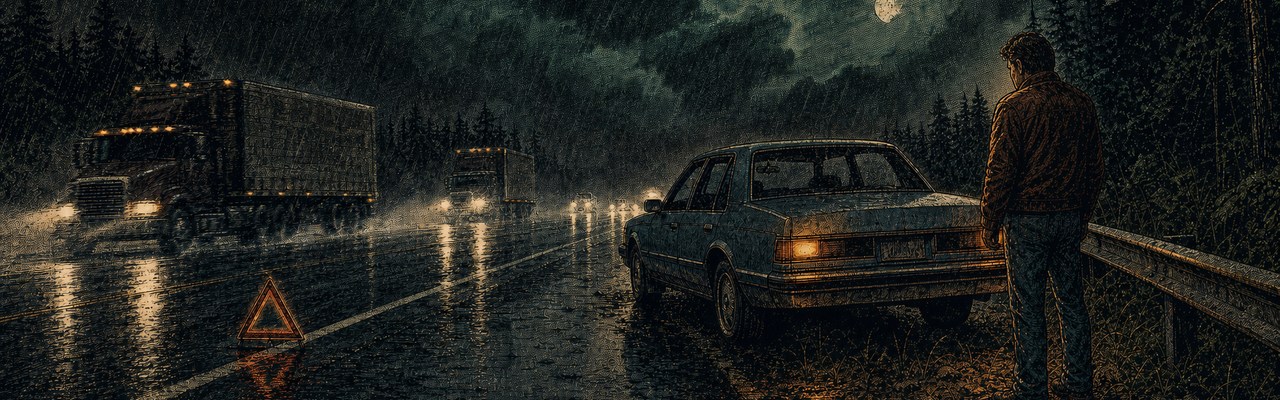
The situation
Headlight failure at night on the highway is a dangerous situation that sharply reduces your visibility and makes you invisible to other drivers. According to NHTSA, 50% of fatal accidents happen at night, even though nighttime traffic is only 25% of the total. In 2023, nighttime crashes claimed 22,000+ lives. The cause: limited visibility, driver fatigue, drunk drivers. Without headlights your visibility drops to zero, and other drivers don't see you until the last second. Modern headlights provide safe visibility up to 48 mph at best; without headlights safe speed drops to 10-15 mph max.
Step-by-step actions
- 1Try the emergency flashers, parking lights and turn signals first — they may still work and give enough light to safely pull off the road.
- 2Turn on the hazard lights immediately — this makes your car visible to other drivers, even if the headlights don't work.
- 3Slow down right away — you can't see the road adequately at normal speeds, reducing speed is critical for safety.
- 4Pull off the road as soon as it's safe — a gas station, parking lot, a well-lit area where you can stop.
- 5If the headlights are dimming rather than fully off — this can indicate alternator failure or a dying battery, drive to the nearest gas station or pull over and call for help.
- 6If you MUST keep driving with limited lighting — use the parking lights plus emergency flashers, drive MUCH slower than usual (AAA: without headlights 10-15 mph max safe speed).
- 7Follow another car at a safe distance — use their taillights to see the road, but keep your distance (they may brake suddenly).
- 8Avoid unlit roads — stick to streets with streetlights where possible, so you can see at least something.
- 9Watch for sudden flashes of light over hilltops and around curves — this means oncoming cars that you can't see directly.
- 10Call AAA at 1-800-222-4357 for a tow or repair — if the bulb replacement is simple and you have a spare, many gas stations or auto parts stores can help.
- 11Call the non-emergency police line if you're stuck in an unsafe spot where pulling off is impossible — they can arrange help or traffic control.
A real case: why this way and not another
How it works: why high beams don't work in fog, but it matters for understanding headlight failure too
This isn't about fog, but it's important to understand for headlight usage. Although high beams give more light ahead, using them at night without headlights is impossible (if the whole system failed). If the headlights work partially, remember: high beams reflect off fog/rain droplets and create a glowing wall in front of you — always use low beams in fog, rain, snow.
How it develops: what's important to understand
Phone numbers
— AAA: 1-800-222-4357 (tow or roadside repair if a bulb replacement is needed)
— Non-emergency police: if you're stuck in a dangerous spot
What to say
- AAA dispatcher: "My headlights stopped working at night on [road name/mile marker]. I pulled off at [location]. I need help getting to a repair shop or a safe place."
- Repair shop: "The headlights failed completely while driving" or "The headlights were dimming" (different diagnoses: a bulb vs alternator/electrical).
What NOT to say/do
- Don't keep driving at normal speeds — you can't see obstacles, pedestrians, animals on the road.
- Don't use high beams in fog/rain (if the headlights work partially) — the reflection creates worse visibility.
- Don't ignore dimming headlights — it's a warning of alternator failure, which can leave you completely without electricity.
Specific situations
Life hacks
- 1Check both headlights regularly — if one burns out, replace BOTH at the same time to avoid uneven brightness (bulbs age together).
- 2Headlight lens maintenance — UV exposure causes oxidation/yellowing of the lenses after 3-5 years (according to AAA), restoration kits are available at auto stores ($15-30) or professional restoration ($50-100 per lens).
- 3Proper headlight alignment — misaligned headlights reduce visibility and blind oncoming drivers; DIY adjustment: park 25 feet from a wall/garage door on a level surface, mark the beam centers, adjust per the owner's manual.
- 4Modern adaptive driving beam (ADB) headlights — NHTSA approved them for new cars starting 2022; they automatically adjust the beam pattern to reduce glare for oncoming drivers while maintaining forward illumination (AAA: up to 86% better illumination than standard).
- 5Daytime running lights are NOT headlights — they don't turn on the taillights and are insufficient for night driving; always make sure the headlights are turned on manually at night.
- 6An emergency headlight repair kit in the car — a spare H11/H7/9006 bulb (check your type), basic tools, can save you if the replacement is simple.
- 7If only one headlight works at night — legal in most states during the day, but illegal at night; drive slowly to the nearest repair.
- 8Cleaning the windshield inside and out — a film on the windshield worsens fog glare at night; a clean windshield is critical for maximum visibility.
- 9Headlight restoration vs replacement — yellowed lenses can be restored for $15-100, a full headlight assembly replacement costs $200-1000+; try restoration first.
- 10States with safety inspections (CA, NY, TX, PA, others) — fail cars with non-functional headlights; periodic checks are mandatory.
Key facts
- Per NHTSA, about 50% of fatal crashes happen at night, even though only 25% of traffic is at night.
- Without working headlights, safe speed drops to roughly 10-15 mph (AAA) — driving a highway at normal speed is deadly.
- Hazard lights make you visible to others but do not light the road ahead of you.
- One working headlight is legal by day in most states, but at night it's a violation.
- A phone flashlight is neither a legal nor an adequate substitute for headlights: it doesn't light the road or show from behind.
- A common cause of a sudden loss of both headlights is a blown fuse; many cars keep a spare fuse and a puller right in the box.
- Slowly dimming headlights (rather than a sudden blackout) usually point to alternator failure or a dying battery.
Test yourself
- a) Keep driving at normal speed to get home faster
- b) Turn on the hazards and pull off the road
- c) Switch on the high beams
- d) Call home to warn them
- a) To light the road ahead of you
- b) So other drivers can see you
- c) To recharge the battery
- d) To scare off animals
- a) A legal and safe replacement for headlights at any speed
- b) Not a substitute: it doesn't light the road or show from behind
- c) Allowed up to 30 mph
- d) Better than the hazards
- a) A burned-out bulb
- b) Dirty headlight lenses
- c) Alternator failure or a dying battery
- d) Misaligned headlights
- a) The oil on the dipstick
- b) The headlight fuse in the box (often a spare and puller are there)
- c) The pressure in all the tires
- d) The coolant level
- a) Drive as usual, one is enough
- b) Drive slowly to the nearest repair — driving like this at night is illegal
- c) Turn on the high beam to compensate
- d) Drive with no lights at all so you don't confuse oncoming traffic
Answers and explanations
Broke down in the woods/desert (no signal)
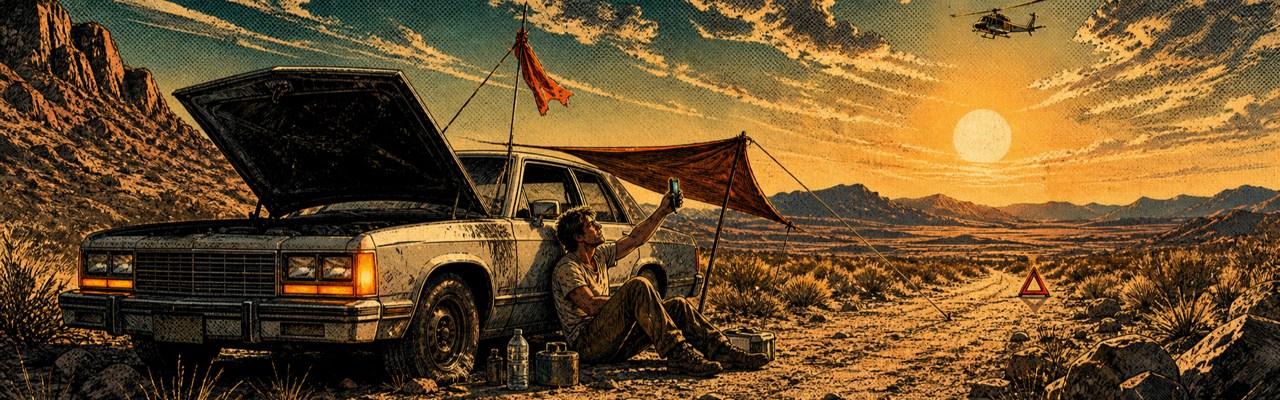
The situation
A breakdown in a remote area with no cell service is a serious emergency situation where your actions determine survival. Vast areas of Alaska, Montana, Wyoming, parts of Utah, Nevada, Arizona, New Mexico have vast stretches without any cell coverage. Even in densely populated states there are dead zones in national parks and remote mountain areas. Without service you can't call for help by standard methods, and your chances of rescue depend on whether you stayed with the car (more visible to search teams) or went looking for help (risky without a clear plan).
Step-by-step actions
- 1Stay calm — panic clouds your judgment and leads to bad decisions that can be deadly in an emergency.
- 2Make the car visible — raise the hood (a universal distress signal), turn on the hazard lights (while the battery works), place reflective triangles 100+ feet behind the car (if you have them), hang bright cloth/clothing on the antenna or window.
- 3Try a 911 call FIRST thing — FCC rule: ANY cell provider that catches a signal MUST route 911 calls, even if it's not your carrier; your phone may show "No Service," but 911 can still connect through another network.
- 4iPhone 14+ and newer — can send an SOS via satellite (no cell signal needed), this feature is built in and requires no subscription.
- 5The decision: STAY with the car OR go for help — this is a critical decision.
STAY with the car (default choice - AAA + Michigan State Police):
When to STAY:
— On a highway or a traveled road (passing traffic will see you)
— The weather is extreme (heat, cold, rain, snow)
— You don't know your exact location or which direction leads to help
— There's no clear destination visible within 2-3 miles
— Night or low visibility
— The car is MUCH more visible to search-and-rescue than a person walking on foot
— The car provides shelter from the elements
CONSIDER walking (AAA Club Alliance) — ONLY if ALL of this is true:
— A clear destination is visible or on the map (gas station, ranger station, building) within walking distance
— Daytime (at least 2+ hours until dark)
— Good weather
— You have proper gear (map, compass, water, warm clothing)
— You left a note inside the car: name, contact information, date, time, the direction you're heading, destination
— You told someone your route by any means possible
- 6If you stay — Survival strategies (Quora + Auto Roamer):
Conserve phone battery:
— Switch to airplane mode (stops the constant search for signal)
— Turn it off when not in use
— Use it only for emergency calls or if a signal appears
Stay warm/cool:
— Run the engine for heat: 10-15 minutes per hour (conserves fuel)
CRITICAL: Check that the exhaust pipe is clear of snow/dirt before starting (carbon monoxide poisoning — CO is odorless, colorless, deadly)
— Use blankets, floor mats, newspapers for insulation
— In extreme heat: seek shade, wet cloth for the neck/wrists, stay hydrated
Signal for help:
— Keep the hazard lights on (while the battery allows)
— Three of anything = a distress signal (3 honks, 3 flashes, 3 piles of rocks, 3 fires)
— Make an X pattern on the ground out of bright materials (visible from the air)
Water and food:
— Ration what you have
— In winter: you can melt snow for water (melt it in your mouth first, don't eat snow directly)
— In the desert: conserve water; travel only in the early morning/evening if you must move - 7Technology Solutions (AAA + Carlift Company):
Satellite Communicators (for frequent remote travel):
— Garmin inReach: two-way messaging, GPS tracking, SOS button (works anywhere on Earth)
— SPOT: GPS tracker with an SOS function
— Cost: $150-400 device + $12-50/month subscription
— Recommendation: program emergency messages ("I am hurt", "I am lost", "Running late") with contact information
iPhone 14+ Satellite SOS:
— Built-in emergency satellite messaging (no subscription)
— Guides you to aim the phone at the satellite
— You can text emergency services or roadside assistance (AAA, Verizon Roadside)
— Slower than a normal text (a few minutes between messages while the satellites move)
Amateur (Ham) Radio:
— Can reach emergency repeaters even in remote areas without cell service
— Requires a license (FCC) - 8Emergency Kit for Remote Travel (AAA Club Alliance):
— Water: 1 gallon per person per day
— Food: non-perishable, high-protein
— First aid kit
— Flashlight + extra batteries
— Whistle (a signal for help)
— Space blanket (emergency warmth)
— Jumper cables, basic tools
— Tow strap
— Lighter (matches in a waterproof container)
— Knife/multi-tool
— Topographic maps + compass (paper backup)
— Cash (ATMs don't work)
— Warm clothing, rain jacket
— N95 masks (protection from smoke/dust)
A real case: why this way and not another
How it develops: what's important to understand
Phone numbers
1. 911 (even without cell service, try several times)
2. Satellite SOS (if you have Garmin/SPOT/iPhone 14+)
3. AAA/roadside assistance (if a signal appears)
4. Park rangers / forest service (if near a national/state park)
What to say
- 911 (satellite or emergency call): "Vehicle breakdown, remote location. [Describe the location: highway name, last mile marker, landmarks]. [Number] of people. Vehicle [make/model/color]. No injuries / Injured party."
- Search-and-rescue: "We stayed with the car. We have [water/food] for [X] days. [Medical needs if any]."
What NOT to say/do
- Don't leave the car without a clear plan — the car = shelter, visibility, protection.
- Don't go "looking for help" if you don't know where — it's easy to get lost, hypothermia/heatstroke risk.
- Don't drink radiator coolant or windshield fluid — they're toxic and deadly.
Specific situations
Life hacks
- 1Tell someone your route before a trip into remote areas — destination, estimated arrival time, so they can "raise the alarm" if you're overdue.
- 2Check the weather forecast before traveling into remote areas.
- 3Fill the gas tank (keep at least 1/2 full) before entering remote territory.
- 4Check tire pressure, the battery, belts, fluids before long trips.
- 5Take an emergency kit (see the list above).
- 6Note where the cell signal drops out — that way you know where to backtrack if needed.
- 7Consider a satellite communicator for frequent remote travel ($150-400 + subscription).
- 8Coverage maps for planning: deadcellzones.com/coverage-maps.html shows where there's no signal.
- 9Paper maps are critical — GPS can die, the phone can run out of battery, but a paper map always works.
- 10A brightly colored car/clothing — easier for search crews to spot.
Key facts
- A person with no water in desert heat can die within 1–2 days, but next to the car in the shade will last noticeably longer.
- FCC rule: any carrier that catches a signal must let a 911 call through — even when the phone shows "No Service."
- iPhone 14 and newer can send an emergency SOS via satellite with no cell service and no subscription.
- Three of any repeated signal (3 honks, 3 flashes, 3 fires) is an internationally recognized distress sign.
- A raised hood and bright cloth on the antenna are standard signals that a car needs help.
- A water supply of 1 gallon (about 3.8 liters) per person per day is AAA's baseline for an emergency kit.
Test yourself
- a) Walk off to look for help
- b) Stay with the car
- c) Wait until dark and then decide
- d) Take the engine apart
- a) May go through on another network — definitely try it
- b) Is useless, don't even try
- c) Only works on your own carrier
- d) Only if you hold the phone up higher
- a) Keep the screen on to notice a signal
- b) Keep calling in a loop
- c) Switch to airplane mode and power up rarely
- d) Share a Wi-Fi hotspot just in case
- a) That the music won't drain out
- b) That the headlights are off
- c) The washer fluid level
- d) That the exhaust pipe isn't packed with snow
- a) Drink it all at once to stop suffering
- b) Ration it and hide from the heat in the shade
- c) Replace water with coolant
- d) Eat snow by the handful nonstop
- a) Nothing, take it all with you
- b) Just an empty bottle
- c) A note: name, time, direction, and destination
- d) The keys in the ignition
Answers and explanations
Panic Attack While Driving
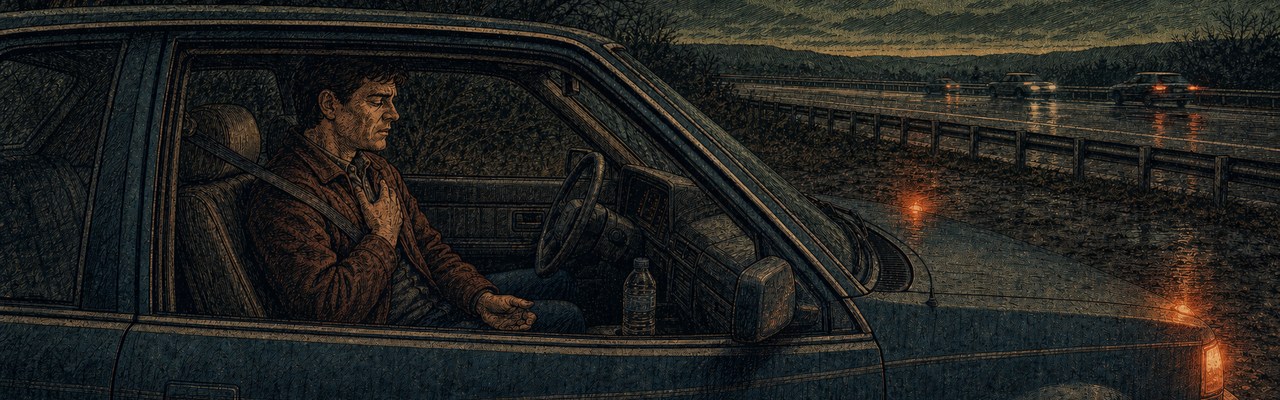
The Situation
A panic attack while driving is a sudden surge of intense fear and physical symptoms that can make operating a vehicle dangerous or impossible. According to the Anxiety and Depression Association of America, about 30% of people experience at least one panic attack in their lifetime. Symptoms include: racing heartbeat, difficulty breathing, dizziness, sweating, trembling, numbness in the limbs, nausea, a feeling of choking, and fear of dying or losing control. While driving, this creates a double danger: the attack itself interferes with concentration and control, and the fear of an attack can trigger a new one.
Step-by-Step Actions
If you feel panic starting while driving:
- 1Stop IMMEDIATELY — at the first signs (racing heartbeat, difficulty breathing, dizziness), pull over to the shoulder, a parking lot, or a safe place. Continuing to drive during an attack is deadly dangerous.
- 2Turn on your hazard lights — so other drivers can see that you've stopped.
- 3Park safely — on level ground, away from traffic, and set the parking brake.
- 4Stay in the car — the vehicle provides a safe space; don't step out onto the roadway in a panic.
- 54-7-8 breathing technique (Dr. Andrew Weil):
— Inhale through your nose for a count of 4
— Hold your breath for a count of 7
— Exhale through your mouth for a count of 8
— Repeat 4-5 times
— This activates the parasympathetic nervous system (calming) - 65-4-3-2-1 grounding technique:
— Name out loud 5 things you can see (steering wheel, tree, road, sky, mirror)
— 4 things you can physically feel (the seat beneath you, the wheel in your hands, the seat belt, the floor under your feet)
— 3 sounds you can hear (cars, wind, your own breathing)
— 2 smells (the car interior, the air)
— 1 taste (saliva in your mouth, water if you have it) - 7Remind yourself of the facts:
— "This is a panic attack, it can't kill me"
— "This will pass in 5-20 minutes at most"
— "I'm safe, I've stopped"
— "Millions of people go through this and survive" - 8Cold water (if you have it) — sip small amounts or splash your face, wrists, and neck. The cold activates the diving reflex (slows the heartbeat).
- 9Call someone (if you can) — a friend, family, someone you trust. Just hearing the voice of someone close can help.
- 10Do NOT keep driving until the attack has passed COMPLETELY plus at least 10-15 minutes afterward — even if you feel better, wait to make sure the attack doesn't come back.
When to call 911:
- 11If this is your first attack ever — it's impossible to tell a panic attack from a heart attack without a medical exam. The symptoms are very similar.
- 12If the chest pain is severe or radiates to your arm, jaw, or back — it could be a heart attack.
- 13If the attack lasts longer than 30 minutes — a panic attack usually peaks within 10 minutes and lasts 5-20 minutes total.
- 14If you feel like you're losing consciousness — don't take the risk, call for help.
A Real Case: Why This Way and Not Another
The Mechanism: Why a Panic Attack Can't Kill You
A panic attack is the activation of the "fight or flight" response. Your body prepares for a threat by releasing adrenaline:
— Your heart beats faster (pumping blood to the muscles)
— Your breathing speeds up (more oxygen)
— Your muscles tense (readiness for action)
— Digestion slows down (energy is redirected)
This is a normal physiological reaction. The problem is that there's no real threat, but the body reacts as if there is. Physically it's SAFE — your heart can beat fast for a long time without harm (marathon runners run for hours with a high pulse). You can't suffocate from hyperventilation (at worst you'd lose consciousness for a few seconds and breathing would resume automatically). The attack ALWAYS passes on its own — it usually peaks within 10 minutes and fully subsides within 20-30 minutes at most.
How it develops: what's important to understand
Phone Numbers
— 911 — if it's your first attack, severe chest pain, lasts longer than 30 minutes, or you're losing consciousness
— National anxiety helpline: 1-800-950-6264
— Crisis Text Line: text "HOME" to 741741
What to Say
- 911 (if you call): "I have chest pain and difficulty breathing. I'm at [location]. I've stopped on the shoulder, my car is a [make/color]."
- To a friend/family: "I'm having a panic attack, I've stopped at [location]. Can you just talk to me while it passes?"
What NOT to Say/Do
- Don't keep driving — "making it home" is impossible during an attack; it's deadly dangerous
- Don't drink coffee or energy drinks — caffeine will worsen the symptoms
- Don't deliberately hyperventilate — slow, deep breathing is better than fast breathing
Specific situations
Life Hacks
- 1Know your triggers — many people experience panic attacks on bridges, in tunnels, on highways (no easy exit), or in heavy traffic. If you know your triggers, you can plan routes to avoid them or prepare in advance.
- 2A card in the glovebox — write on a card: "I'm having a panic attack. It's safe. I've stopped. Breathe 4-7-8. Grounding 5-4-3-2-1. This will pass." During an attack your thinking is foggy, and the card will remind you what to do.
- 3A bottle of cold water in the car — the cold helps activate the parasympathetic system (calming).
- 4Practice the techniques at home — practice 4-7-8 breathing and 5-4-3-2-1 grounding when you're NOT in a panic. When an attack starts, the techniques will be more automatic.
- 5Avoid an empty stomach — low blood sugar can trigger panic symptoms. Have a light snack before the trip.
- 6Don't avoid driving — complete avoidance worsens the fear over the long term. If you fear having an attack behind the wheel, start with short trips at safe times and gradually increase.
- 7Cognitive behavioral therapy — if panic attacks are recurring, therapy is very effective (80%+ success rate according to the National Institute of Mental Health). It teaches you to manage your thoughts and reactions.
- 8Medication if needed — some people keep prescribed anti-anxiety medication in the car "just in case." Even just knowing it's there reduces anxiety. Consult a doctor.
- 9A playlist of calming music — a pre-made list of slow music (60-80 beats per minute) can help slow your heartbeat.
- 10Tell passengers in advance — if you're driving with someone and you've had attacks before, tell them "If I feel a panic attack, I'll stop for a few minutes, that's normal." It reduces the pressure to hide it.
Key facts
- About 30% of people experience at least one panic attack in their lifetime (per the Anxiety and Depression Association of America).
- A panic attack usually peaks within 10 minutes and fully passes in 5-20 minutes, 30 at most.
- The symptoms of a panic attack and a heart attack are nearly indistinguishable without a medical exam.
- 4-7-8 breathing activates the parasympathetic nervous system and slows the heartbeat.
- Caffeine can worsen or trigger panic symptoms.
- Cognitive behavioral therapy is effective in over 80% of panic disorder cases (per the National Institute of Mental Health).
Test yourself
- a) Speed up and make it home
- b) Pull onto the shoulder and stop
- c) Keep driving and "tough it out"
- d) Drink an energy drink for a boost
- a) 4-7-8: inhale for 4, hold for 7, exhale for 8
- b) Breathe as fast and deep as you can
- c) Hold your breath for a minute
- d) Pant quickly through your mouth
- a) Wait, it'll pass on its own
- b) Drink water and keep driving
- c) Stop and call 911 — the symptoms mimic a heart attack
- d) Lie down to sleep in the car
- a) Several hours straight
- b) 5-20 minutes, peaking around minute 10
- c) The whole day
- d) Until an ambulance arrives
- a) Yes, from the heart bursting
- b) Yes, you can suffocate
- c) Yes, it's deadly
- d) No, it's physically safe and the attack always passes
- a) Yes, coffee is calming
- b) Yes, you need the caffeine
- c) No, caffeine will worsen the symptoms
- d) Yes, better with an energy drink too
Answers and explanations
Undocumented Immigrant in a Car Crash
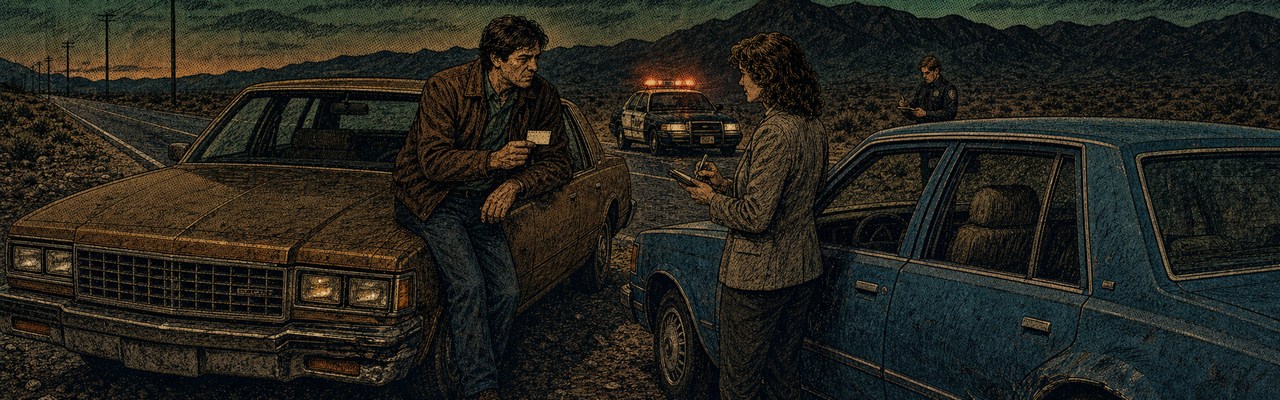
The Situation
A car crash poses a dilemma for someone without legal status in the U.S.: stay and interact with the police (risk of deportation) or leave (a guaranteed crime). It's important to understand: leaving the scene of an accident is a separate serious crime that guarantees a worse outcome than staying. You have constitutional rights regardless of immigration status, including the right to remain silent and the right to an attorney.
Step-by-Step Actions
- 1STAY at the scene of the accident — leaving the scene turns a minor incident into a serious crime (hit and run), which guarantees arrest, jail, and deportation. Staying gives you a chance to avoid serious consequences.
- 2Check whether anyone is injured — help if someone is hurt, and call 911 if an ambulance is needed.
- 3Exchange information with the other driver:
— Name
— Phone number
— Insurance information (if any)
— Vehicle make and model
— License plate - 4Do NOT volunteer your immigration status — the police are not required to ask about it during an ordinary accident. If they ask — see the "What to Say" section.
- 5Photograph the scene of the accident — damage to both cars, the overall view, and license plates (if you have a phone).
- 6Call 911 if:
— Someone is injured
— The cars are blocking traffic
— The other driver is aggressive or drunk
— The damage is significant (most states require a police report if the damage exceeds $500-1000) - 7When the police arrive — cooperate regarding the accident, but use your constitutional right to remain silent for questions about your status.
- 8What to say to the police (in detail in the "What to Say" section below):
— About the accident itself — answer truthfully
— About immigration status — the right to remain silent
— About a license — "I don't have a license" (if true)
— Do NOT give false information (that's a separate crime) - 9Do NOT sign anything you don't understand — ask for an interpreter if you need one.
- 10Write down the officer's name and badge number — for follow-up actions.
- 11After the incident — consult an immigration attorney as soon as possible.
A Real Case: Why This Way and Not Another
The Mechanism: Your Constitutional Rights
The U.S. Constitution protects all people on U.S. soil, regardless of immigration status. The Fifth Amendment guarantees:
The right to remain silent: You are not required to answer questions that could incriminate you. Questions about immigration status fall into this category.
The right to an attorney: You have the right to an attorney, although the government is not required to provide a free attorney in immigration cases (only in criminal ones).
The Fourth Amendment: Protection from unreasonable searches. The police cannot search your car without probable cause or a warrant.
Important: These rights don't mean you can't be deported, but they give you the tools to protect yourself and not make the situation worse.
How it develops: what's important to understand
Phone Numbers
— 911 — if someone is injured, the cars are blocking the road, or it's a serious accident
— Immigrant helpline (Immigrant Defense Project): 1-844-363-1423
— American Civil Liberties Union (ACLU): 1-877-336-8187
— Free legal aid: Find it through immigrationlawhelp.org
What to Say
- To the police about the accident itself: "I was driving [direction], the other car [what it did]. I braked/turned. A collision happened." (The truth about what happened)
- If the police ask "Do you have a driver's license?": If you don't have a license: "I don't have a driver's license" (true — don't lie). Don't add "because I'm undocumented" — just the fact that you have no license
- If the police ask "Where were you born?" or "What is your status?": "I want to exercise my right to remain silent. I'd like to speak with an attorney." (Calmly, politely, clearly)
- If the police insist: Repeat: "I understand your job, but I'll exercise my right to an attorney for any questions about my status."
- To the other driver: "Let's exchange information. Here's my phone number [if you're willing to give it]. Here's the car's information." (You're not required to give all your personal information; a phone number and the car's information are enough for the insurance company)
What NOT to Say/Do
- Don't leave the scene of the accident — leaving the scene = a felony, guaranteed deportation
- Don't lie — giving a false name, false documents, or false information is a separate crime (significantly worse than simply remaining silent)
- Don't volunteer your status — "I'm undocumented" makes the situation worse needlessly
- Don't sign documents in English if you don't understand them — ask for an interpreter
Specific situations
Life Hacks
- 1Sanctuary states (safer policies): California, Colorado, Connecticut, Illinois, Massachusetts, New Jersey, New York, Oregon, Vermont, Washington. Police in these states usually don't cooperate with immigration enforcement for minor traffic incidents.
- 2States with active cooperation: Texas, Arizona, Georgia, Alabama, South Carolina. Police may check status more aggressively and cooperate with immigration enforcement.
- 319 states + Washington, D.C. issue driver's licenses regardless of immigration status: CA, CO, CT, DE, HI, IL, MD, MA, MN, NV, NJ, NM, NY, OR, RI, UT, VT, VA, WA, DC. If you live in one of them, get a license — it legally reduces your risk.
- 4A "know your rights" card — the American Civil Liberties Union provides cards in different languages with information about your rights. Keep one in the glovebox and show it to the police if needed.
- 5An attorney's number in advance — find an immigration attorney BEFORE an incident (through immigrationlawhelp.org or local immigrant aid organizations). Save the number in your phone. If something happens, call right away.
- 6Insurance if possible — some states let you buy auto insurance without a driver's license (you only need the car's number). This protects you from civil liability.
- 7Don't drive if you can avoid it — ideally use public transit, rideshare, or a licensed driver. Driving without a license is always a risk.
- 8Document everything — photos, recordings, witnesses' names. This helps an attorney defend you later.
- 9A plan with your family — if you're the only driver in the family, have a plan: who will pick up the kids from school if you're arrested, where important documents are, attorneys' numbers.
- 10Don't panic — panic leads to bad decisions (leaving the scene, lying). Stay calm, remember your rights, get help.
Key facts
- The U.S. Constitution protects all people on U.S. soil regardless of immigration status; the Fifth Amendment gives the right to remain silent.
- Leaving the scene of an accident is a crime in all 50 states, even with minor damage.
- 19 states and Washington, D.C. issue driver's licenses regardless of immigration status.
- In sanctuary states the police usually limit cooperation with federal immigration enforcement over minor traffic incidents.
- In immigration cases the government is not required to provide a free attorney — unlike in criminal cases.
- Some states let you buy auto insurance without a driver's license — using only the car's number.
Test yourself
- a) Leave before the police arrive
- b) Stay at the scene — leaving turns it into a criminal case
- c) Give a false name
- d) Run away on foot
- a) Name your country of birth
- b) Lie and say you were born in the U.S.
- c) "I'll exercise my right to remain silent and I want an attorney"
- d) Show any documents
- a) Honestly say "I don't have a license"
- b) Show someone else's license
- c) Hand over a fake one
- d) Stay silent and run
- a) Drive off in a panic
- b) Give them money
- c) Agree to everything
- d) Stay calm, exchange the car's information, and document the threats
- a) Staying silent about your status
- b) Giving the police a false name or fake documents
- c) Asking for an interpreter
- d) Photographing the scene
- a) Delete the photos
- b) Tell no one
- c) Consult an immigration attorney
- d) Change your phone
Answers and explanations
Phone Died (No Signal/GPS)
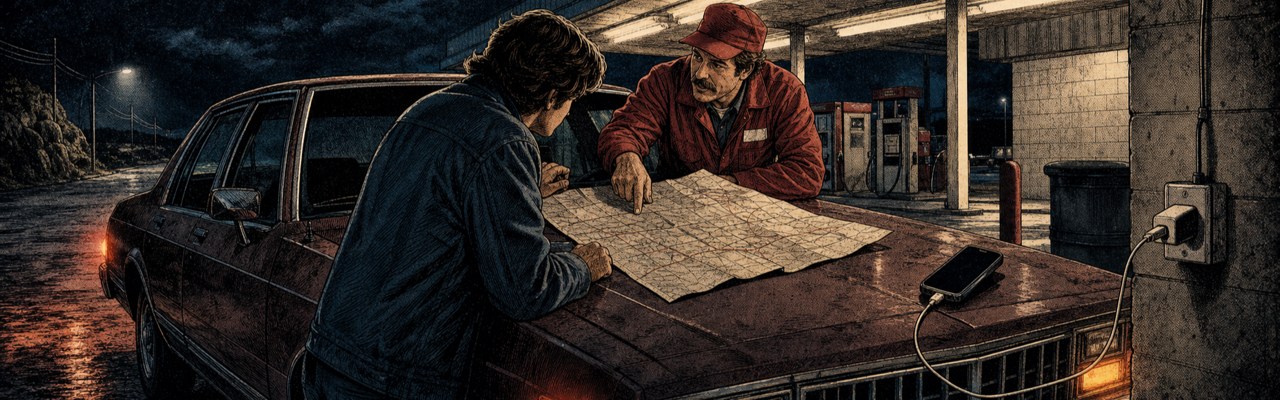
The Situation
A dead phone while driving cuts you off from navigation, communication, and help. This is especially dangerous if you're lost, unfamiliar with the area, or in need of emergency assistance. Modern driving relies heavily on smartphones — most people use a phone for navigation instead of paper maps. When the battery dies, you suddenly lose the ability to find your way, call for help, or even know where you are. The key is to not panic and to use the resources available.
Step-by-Step Actions
- 1Don't panic — a dead phone is inconvenient but manageable. Millions of people drove without phones for decades; you'll manage too.
- 2Look for landmarks:
— Road signs with street names
— Mile markers (on highways, every mile)
— City names on green signs
— Highway and exit numbers
— Memorize or write down this information - 3Stop at a gas station or store:
— Ask permission to charge your phone (most will give you access to an outlet if you ask politely)
— Ask for help with directions — the staff can tell you how to get there
— Buy a car charger if they have one (usually $10-20) - 4Call from someone else's phone if you need help:
— Ask someone to lend you a phone for a quick call
— Most people will help if you explain the situation
— Call family, a friend, or a help service - 5Try calling 911 even without a signal — emergency calls can go through even when regular ones won't. Any cell provider in range MUST route a 911 call (FCC rule), even if it's not your carrier.
- 6Move to higher ground for a better signal — a hill, a bridge, or open terrain usually has better reception than low areas, tunnels, or dense forests.
- 7Airplane mode for 30 seconds, then turn it off — this resets the connection to the towers and sometimes helps catch a signal.
- 8Use old-fashioned navigation methods:
— Follow main roads toward known cities
— Ask people for directions
— Look for signs to major highways - 9If you're completely lost — stay put (in a safe parking spot) until morning or until you find help, especially if it's night or the weather is bad. It's better to wait than to get even more lost.
- 10When you find a charger — even 5-10% of battery is enough for 20-30 minutes of navigation. Use that window to load directions, call whoever you need, and keep charging.
A Real Case: Why This Way and Not Another
The Mechanism: Why 911 Can Work Without a Regular Signal
FCC rule: ALL cell providers are REQUIRED to route 911 calls, even if the caller isn't their customer. Your phone may show "No Signal" for your carrier, but if ANY tower in range picks up a signal (even a competitor's), the 911 call should go through. In addition, for 911 the phone uses more transmission power than for regular calls, which increases its range.
Phone Numbers
— 911 — try it even if it shows "no signal"
— Roadside assistance (if you have a subscription): the number is usually on a card in the glovebox
How it develops: what's important to understand
What to Say
- At a gas station/store: "Sorry, my phone died and I'm lost. Can I charge my phone for a couple of minutes? Or could you tell me how to get to [place]?"
- Asking to borrow a phone: "I have an emergency, my phone died. Can I make a quick call? It'll take a minute, I promise."
- 911 (if you get through): "My phone died and I'm lost. I'm at [describe your location: the last sign you saw, landmarks]. I need help getting to [place]."
What NOT to Say/Do
- Don't keep driving at random if you're lost — it only makes the situation worse
- Don't leave the car in a deserted/remote area — the car is more visible than a person and provides shelter
- Don't panic — the phone died, but you're alive, the car works, and help is available
Specific situations
Life Hacks
- 1A car charger is a must — always keep a charger plugged into your car's cigarette lighter. It costs $10-20 and saves you in situations like this. Better to keep a spare in the car at all times.
- 2A portable charger (power bank) — keep a charged one in the glovebox. It can give 1-2 full phone charges. Check its charge once a month.
- 3Write the address on paper before a trip to an unfamiliar place — if your phone dies, you'll have a physical copy of where to go and can show it to people.
- 4Download offline maps — Google Maps and other apps let you download areas for use without internet. Download your city and the places you go often.
- 5A paper atlas in the car — old-fashioned, but it works without battery or signal. Buy an atlas of your state for $10-15 at an auto store.
- 6Charge your phone to at least 50% before any trip — don't rely on "the battery will last"; charging takes 20 minutes and can save you hours of trouble.
- 7Know the main highways in your area — if you're lost, a general goal like "get to Route 95" is easier than a specific address, and you can ask anyone.
- 8Battery saver mode — turn it on when the battery drops to 20%; it extends the life by an hour or more.
- 9Close unnecessary apps — turn off navigation, music, and everything else to extend the battery for critical functions.
- 10A screenshot of the map before a trip — take a screenshot of the route from navigation; if your phone dies, at least you'll have a static picture of the directions.
Key facts
- A 911 call must be accepted by any carrier's tower — even if your phone shows "no signal."
- GPS finds your location from satellites and needs no cell service — only maps downloaded in advance for offline use.
- In a no-reception area the phone drains faster because it keeps hunting for towers; airplane mode saves the charge.
- Even 5–10% of battery is enough for 20–30 minutes of navigation.
- iPhone 14 and up (and some Android phones) can send an Emergency SOS via satellite with no cellular service.
- A car charger costs $10–20 and brings navigation back within minutes.
Test yourself
- a) Drive at random until you find your way
- b) Stop at a gas station — charge the phone and ask for directions
- c) Leave the car and set off on foot for help
- d) Wait for the phone to turn itself back on
- a) Yes, GPS comes from satellites and works with offline maps
- b) No, GPS is useless without a network
- c) Only if you call your carrier
- d) Only in the city
- a) No, no signal means it's useless
- b) Only from your own carrier
- c) Yes, try it — the call goes through any tower
- d) Reboot the phone first
- a) Keep checking whether the signal is back
- b) Turn on the flashlight to save power
- c) Call every five minutes
- d) Turn on airplane mode so the phone stops hunting for a network
- a) Drive at random looking for the way out
- b) Stop in a safe, well-lit place and wait for help
- c) Leave the car and go on foot
- d) Turn off the headlights and wait in the dark
- a) Music for the road
- b) Games while it charges
- c) Load the route and call whoever you need
- d) Update your apps